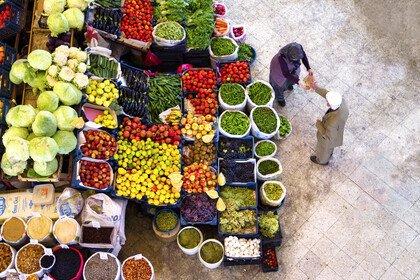
Food systems – what needs to change?
Food systems define how we produce, process, sell and consume food, and are influenced by a diversity of policies and interests. Delivering healthy, environmentally sustainable and resilient food systems increasingly requires coherent policy action and partnership across sectors that recognises the impacts of climate change.
Why we're concerned about food systems
It is becoming more difficult to produce safe, nutritions and affordable diets in a changing climate. Heatwaves, droughts, floods and air pollution all affect yields and food quality. Increased temperatures and extreme weather events also contribute to foodborne diseases. Each year, 866 million people fall ill and 1.52 million people die after eating unsafe food.
Inability to access nutritious diets and unhealthy eating patterns are now the leading causes of death and ill health globally. At the same time, dietary choices and damaging food production practices also contribute to climate change – food production accounts for up to a third of global greenhouse gas emissions.
The food security and health of millions of people across the planet is already being impacted, with lower and middle income countries especially affected.
What we can do about this
We need policies and food environments that help give people more choice around affordable, culturally desirable, healthy and sustainable foods. Enabling people to eat well and in line with the Planetary Health Diet could prevent around 15 million deaths every year whilst reducing emissions from food systems by more than half.
Many solutions already exist to transform food systems for climate, health and resilient economies but we need to do more. Research and innovation plays a role in enabling these solutions to be realised equitably, as well as investigating new challenges and solutions on the horizon.
We fund climate and health food systems research and have supported projects exploring healthy and planet-friendly food marketing policies, crop diversity and food security, and the health and economic impacts of dietary changes.
Food systems explained
Learn more about food systems and why they are one of our priorities.
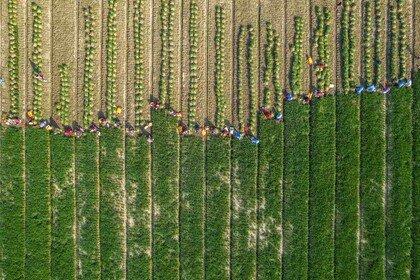
In this episode of our podcast, ‘When Science Finds a Way’, Alisha Wainwright speaks with Professor Peter Scarborough, who is co-leading research into how dietary choices affect health and climate.
Pressing play on the video above will set a third-party cookie. Please read our cookie policy for more information.
Introduction
Professor Peter Scarborough, Professor of Population Health, University of Oxford: It's not just about saying we want everyone to turn vegan. Just by small changes, by just reducing the amount of meat and dairy that are consumed, you can actually have a really big effect on the overall environmental footprint of the diet.
Alisha Wainwright, presenter When Science Finds a Way podcast: Welcome to When Science Finds a Way, a podcast about the science changing the world. I'm Alisha Wainwright, and this is where you'll hear stories of hope from people on the front line of our biggest health challenges – challenges like climate change and the food system.
As we've heard on this podcast before, food production is a huge contributor to global warming. Around 25 to 30% of greenhouse gas emissions come from the growing, transporting, processing and packaging of what we eat. It's even higher if you include what happens after it leaves the shop, like how we cook it and how food waste is dealt with.
So, how can we make sure that the food we eat is not only healthy, but also sustainable? It's a complicated question, especially when we all have such varied diets with different food grown in different places and produced in different ways around the world. My guest today is trying to help us figure some of this out.
Professor Peter Scarborough: We're trying to find some policies that the public would support, that policy makers would support, and crucially that the food industry, the people who are delivering most of the food that we consume would support, could get behind and actually implement, but crucially as well that would actually have an effect.
Alisha Wainwright: Professor Peter Scarborough is a professor of population health and leads a sustainable healthy food group at the University of Oxford in the UK.
He's an expert at modeling how changes to diet can affect population health, sustainability, and economics. He put these skills to use as a lead investigator for a recent research project called LEAP.
LEAP stands for livestock, environment, and people. It focused on the impact of meat and dairy consumption, and it's one of the things we'll be discussing today. So, Pete, welcome to When Science Finds Away.
Professor Peter Scarborough: Delighted to be here. Thank you very much for inviting me.
Why does what we eat matter?
Alisha Wainwright: So, let's start with a really softball question. Why does what we eat matter?
Professor Peter Scarborough: Well, in terms of sustainability, it's really, really important. As you mentioned, at least a quarter of the global greenhouse gas emissions are coming from food. And of course, that's not the only impact on the environment that food is having. It's the biggest contributor to biodiversity loss on the planet. It also causes things like water scarcity and eutrophication, which is water pollution, effectively.
And all of these problems are really related not only to production of the food we eat, but also the types of foods that we're producing because different foods have very different impacts. So changing the kind of food that we eat can have an impact on its overall environmental impact.
Alisha Wainwright: Right. And when it comes to food, what has the biggest impact on the environment? I mean, meat and dairy seem like obvious villains, but how true is that assumption?
Professor Peter Scarborough: Oh, it's definitely the case. I'm afraid that meat and dairy are definitely the standout pieces of lowest sustainability in the food world.
Methane is a greenhouse gas. It is about 30 times as potent as carbon dioxide and cows and sheep produce a lot of it. They burp it out. But really the main reason why animal source foods are much less sustainable than plant-based foods is because of inefficiencies.
A hell of a lot of the food we grow on the planet is just used for animal feed. Now, whenever you're growing any type of food, it's having an impact on the planet. And if you're doing that, but then the food that you're producing, you're feeding to animals, then only a small proportion of those calories you're growing end up as human food – you're building loads of inefficiencies. And that's why the meat production and dairy production is so much worse for the planet than plant-based production.
Are there countries or regions where diets are contributing to climate change more than others?
Alisha Wainwright: So what does the global picture look like? Are there some countries or regions where our diet is contributing to climate change more than others?
Professor Peter Scarborough: Oh, without a doubt, Western diets, high-income country diets, are the diets which are having the biggest impact globally. But we need to be absolutely clear about what we're talking about here. We're talking about consumption rather than production because of course the foods that we eat might be produced in lots of different regions around the world. So really what we're looking at is, what are the overall environmental impacts of the foods we as a population consume, rather than produce.
The countries that have higher consumption of animal-based foods, higher consumption of meat have a higher environmental footprint – they're all Western high-income countries. And what we're seeing is, in countries that are going through economic development, we're seeing a shift towards more Western diets. So we're seeing a big increase in the meat and dairy being consumed in those countries.
I don't want to suggest in the slightest that countries moving towards more Western diets somehow shoulder more of the blame for the high environmental impact of the food system. They don't. They're currently eating much, much lower meat and dairy than is consumed in high-income Western countries. But that trajectory of increase there means we're going to be running out of space very soon. If we continue with these trends going forward, we're going to need more land. That means less forest and that means more environmental impact.
Is a sustainable diet also a healthy diet and vice versa
Alisha Wainwright: So in terms of sustainability, I and maybe other people sometimes get confused with what we should be eating. Is this where LEAP comes in?
Professor Peter Scarborough: Yeah. So the title is Livestock, Environment and People. We wanted to particularly focus on livestock – so production of animal products both meat and dairy. But we wanted to look at its impact both on health and on the environment simultaneously. And we really wanted to try and tackle this by looking at diets, so what people are actually consuming, and farming, so what people are producing.
We wanted to test the idea of whether a sustainable diet is also a healthy diet and vice versa. Where are the complimentarities? Where are the trade-offs?
We did that by doing a lot of work joining data sets together so we could look at both environment and health simultaneously. And by doing projects where we basically model different global scenarios saying, “Okay, well if this is the food that's being produced in different regions of the world, if this is the food that's being consumed, then what's the health impact and what's also the environmental impact of those different diets?”
So we're looking to try and see, if there is a focus on meat and dairy, are we going to see co-benefits? Are we going to see a reduction in environmental impact and an advantage in terms of health for populations as well?
Finding out the environmental and health impact of products on supermarket shelves
Alisha Wainwright: Okay. So, as you mentioned, one key aspect of LEAP was modeling the environmental impact of particular diets. Can you talk me through that aspect and the data set you built?
Professor Peter Scarborough: The first thing we did was try some global scenarios because what we're looking at here with the food system, it's important at a global level. We need to be finding solutions to keep us within global environmental kind of boundaries if you like.
We had a health model built that basically said, if a population is eating different foods then what would be the health impact in terms of cardiovascular diseases, cancers and other diet related diseases. The other thing we did was to link up a lot of data sets so we can look in very clear detail at one particular country, the UK, and the environmental impact of specific foods.
Here in the UK there's been loads of rich data for a good long time around the environmental impact of food as it's grown on farms. But of course when we go to the supermarket, we don't see the food that's grown on farms. You don't see wheat and barley and whole pigs. We've got foods that are a combination of these things. We see pizzas, we see lasagnas, we see ice cream and all of these multi-ingredient foods.
There's never really been a strong comparable system that can link up the data on the environmental impact of the food as it's produced at the farm that takes you through to the environmental impact of a specific product that we see on the supermarket shelf.
So we built an algorithm that allowed us to do this by linking that good rich on-farm data and mapping it to specific food items – farm commodities if you like. You can then start saying, this is the overall environmental footprint of this specific food item.
We published a paper back in 2022 that allows us to produce estimates for 57,000 different foods that are available in the UK and Ireland. And the approach can basically be used for anything that's got an ingredients list on the back of it. So, it can be extended out further than that. And then that's a really powerful data set.
Alisha Wainwright: So, what did your modeling show you about the impact our dietary choices are having or could have?
Professor Peter Scarborough: The lower amounts of meat and dairy in your diet, the lower your environmental footprint related to that diet. So the vegans, for example, had a footprint that was far, far lower than the meat-eaters in our study. But even if you just reduce your meat consumption by a small amount, you get really substantial reductions.
So if you move from a high meat eating diet – in our study that was meat-eaters that ate more than 100 grams of meat per day, roughly a kind of average meat consumer from the UK – if you went down to a low meat diet, so reducing your meat consumption to less than 50 grams per day, then you reduce the greenhouse gas emissions from your diet by about 30%.
So you can get a really massive reduction just by a small change in your diet. And that's the real crucial bit that emerges from research that's done like this. It's not a black and white picture. It's not just about saying we want everyone to turn vegan. Just by small changes, by just reducing the amount of meat and dairy that are consumed, you can actually have a really big effect on the overall environmental footprint of the diet.
We know that’s going to be good for us as well. We know that's going to be healthy because we know reduced meat diets are better for health. We've seen that from the epidemiological data. We've seen for example, specifically with red meat and processed meat, that they're related with dietary risks particularly colorectal cancer, increased risk of those diseases. And all of the diets we saw that had reduced meat and dairy in them also had increased amounts of fruit and vegetable consumption. And fruit and vegetables are really, really good for our diet. So we’re moving people towards healthier diets if we're shifting people away from meat and dairy.
How do you actually change what people are choosing to eat or or buy?
Alisha Wainwright: That's really interesting that eating less meat generally leads to a diet that's better for our health. I think there's often this concern that you might be missing out on protein, but you can get this from plant sources. And I know research has shown that most of us here in the US are eating about 20% more protein than we need anyway.
Okay. So, you've built this amazing data set. Where do you go from here? How do you actually change what people are choosing to eat or or buy
Professor Peter Scarborough: Well, that is the 64 million pound question and that's what we're looking at trying to do at the moment. In this field of research, we got to the point where it's really established what a healthy sustainable diet is. We know what it should look like. We know what we should be aiming for. The question is how do you get people to actually do it? How do you get people to move in that direction? And that's where all the research is moving to now.
Since we finished the LEAP project, we've started up a few different projects. One called SALIENT, one called SHIFT, one called THRIVING. And if I told you what these acronyms stood for, you wouldn't believe me because they're so contrived. So, I won't go into detail about what they mean, but they all have a common theme – they're all about trying to discover policies and interventions that help move people towards more sustainable diets.
We want to try and find policies that the public would support, that policy makers would support, and crucially that the food industry, the people who are delivering most of the food we consume, would support and could get behind and actually implement. But crucially, that would actually have an effect.
We have a whole range of research that's built around, first of all, co-designing policies and interventions. That means working with the public, working with policy makers, working with the food industry to say, tell us what you think would be a useful activity, a useful intervention or a policy that could help you achieve low meat, healthier, more sustainable diets.
But then crucially, doing field trials of those – taking those interventions, those policies, and trying them out in settings where people are actually making food choices.
We try to do that in as robust a study as possible. So wherever possible a randomised trial – an experimental study saying, we introduced this intervention or this policy, what impact did it have? And we try to measure and see what's successful. Then we can take that back to the policy makers and say here you go, here's your suite of interventions, here's your policies, this is what you should be basing it on because this is how you can make real change in this area.
The trial seeking to change behaviour in online food shoppers
Alisha Wainwright: One of the trials that's taking place as part of this latest work is called SUSTAINED. It's led by Thijs Van Rens at the University of Warwick and is exploring how people might be nudged to change their behavior when shopping for food online through a plug-in that links to a website of a major UK supermarket.
When customers shop online, they're given eco-ratings for their food. Basically, a traffic light system from green to red that reflects the environmental impact. They're also offered more eco-friendly alternatives when they check out, sometimes at a discounted price.
We spoke to Jo, who's taken part in the trial. She lives in the north of England with her husband and two kids and is responsible for their weekly food shopping. She showed us how the plug-in worked and the impact it had on her shopping habits.
Jo, UK shopper and trial participant: This is the website where I do my shopping. Let's type ‘chicken’. As you can see here, we've got the traffic lights. When you click on ‘checkout’, it then offers you a substitution.
I really like the eco ratings because even if I only go for a product that's one better than I would have gone for, it still feels like I am doing something. And it might only be a teeny tiny difference that I'm making, but I am making a change.
I found that most meat is quite low in terms of sustainability, which I hadn't necessarily been prepared for. I think I thought some would be really low and some would be really high whereas actually most of what I was searching for seemed to be quite low.
I will try and factor in one meal a week that is meat free but that hasn't always been a welcome decision from my family, shall we say. So seeing clearly on the screen when I'm buying those ingredients they're all green and when I'm buying the meat it's all red, that's just a really clear indicator to me that we need to be having more of those types of meals.
On one occasion where I did accept a swap, I thought the cost was not significantly more than the item that I had chosen. The meal I had planned wouldn't have been adversely affected by this swap and it was being presented to me as a more sustainable option. So it felt, why not give it a go.
The sustainability side of things was something I was aware of but often felt, and still do to an extent feel, slightly overwhelmed. It’s knowing where to start with it all and feeling like there's not very much I could do personally to make a difference. Then weighing that up with other factors like the cost and will my children eat this food.
I think you want to shop well and conscientiously, but there are other factors at play and to change that and to consciously think about making changes is more to think about and more work essentially. So I do find making those changes tricky, but small things like the traffic lights and the substitutions can help towards that, can't they?
I've kept the plug-in on my browser so I can still see those traffic lights each week when I'm shopping. And I will continue to use that and be guided by the traffic lights and recommendations along the way.
Alisha Wainwright: I too can relate to Jo's sense of overwhelm and I'm glad she found the plug-in to be very helpful to her after the study. But Pete, tell me a bit more about how these eco ratings are calculated and what they're telling Jo about her shopping.
Professor Peter Scarborough: So they're using similar data to that I described earlier around how we link up the environmental footprint of foods to the actual product that is available on the store shelf. It's taken an extra layer by then looking at the environmental footprint and, rather than just presenting the total amount, combining lots of different variables. So greenhouse gas emissions, biodiversity impact, water use – lots of different environmental impacts – combining them into one index and then presenting them as a kind of colour-coded scale for people to follow.
This is not dissimilar to what's done in lots of places around the healthiness of food. So if you go around Europe, there's a commonly used scale called nutri score, which is a traffic light that goes from A to E to basically give a pictorial representation about the healthiness of food. Same thing going on here, but looking at environmental indicators instead of nutrition.
Alisha Wainwright: And why are the swaps and the discounts also important?
Professor Peter Scarborough: I think Jo's point there about it being really, really complicated – we cannot ignore that.
You give people more information, like labeling, and you're throwing it into a really crowded, really difficult marketplace. That's one more thing to think about. You're thinking about, “What are we going to get to feed the kids? Is it going to be tasty? Is it within my budget?” And now you're thinking about sustainability as well.
So it's good that we've got those eco labels and they could be really, really helpful in that regard. But let's not kid ourselves. We're not going to get anywhere with eco labels alone because it's such a congested marketplace. We need to do something more. We need to make the more healthy, more sustainable choice the easy choice to make.
The swaps in that particular study and their price discounts is one way of doing it. So, it's making sure with the swaps that it's very prominent when people are making their decisions, saying, "Oh, here's something else that might work for you." With the price discount, that's more obvious because it's about saying, "Okay, we can make it cheaper, that's a better choice for you”.
Alisha Wainwright: So SUSTAINED just looked at environmental impact data. How do you then build in the health aspect in terms of the health outcome?
Professor Peter Scarborough: We're going back onto our health models that I discussed back in the LEAP project. So all we can do in these little experimental studies is just say well what's the short-term impact? So people changed their diet. So what did it look like for salt levels? What did it look like for sugar levels? But we know how salt and sugar and fruits and vegetables and processed meat impacts your health long term. So we can put those into health models in order to translate those results from those trials into what's going to happen over a long term if it was adopted at scale.
Alisha Wainwright: What impact are you hoping to have with these behavior change trials? And is it just about influencing customers or are there bigger policy change ambitions?
Professor Peter Scarborough: Personally, I wouldn't be doing this research if I didn't think that it could have policy impacts long term. I think the goal has to be to try and produce evidence which is going to influence policy.
What's really, really important is that you don't create inequalities. We already have inequalities in the food system, big, big inequalities, and you don't make those worse.
Fortunately, one of the ways to make sure you're trying to reduce inequalities is to work on policies that are more upstream. By that I mean changing the environments which influence how we make food decisions.
If we're changing the way a supermarket looks, operates and promotes its foods, then it's going to be affecting everyone in the supermarket equally. If we're doing stuff that relies on the individual to take a lot of agency and make their own decisions such as providing eco labelling on foods, then you've got a problem because then that can actually exacerbate inequalities. Only some people in the population are actually going to react to those differences and those changes.
What role do government policies play in shaping sustainable diets?
Alisha Wainwright: What role do government policies play in shaping sustainable diets? And are there any initiatives you find particularly promising?
Professor Peter Scarborough: There's two good examples I usually go for. One is smoking – an example where we built up lots and lots of evidence to demonstrate clearly that smoking is bad for your health. Forced governments to act and start restricting the availability of cigarettes. And basically, they threw the kitchen sink at it. They did everything.They made them more expensive. They made the packaging horrible. They made them not able to promote themselves on TV. They took them off of sports gambling and advertising. That shows that policy tools we've got available can really make a difference because we saw a big fall in smoking statistics over time in countries that implemented all of these policies. So that's telling us if you join up policy action in an area, you can really change the dial.
The other thing I use as an example is whole milk consumption. So whole milk consumption in the UK was going along really nice and steady until about the late '70s, early 80s. Then it fell away really, really quickly because there was a new disruptor in the marketplace which was skimmed milk. People thought, “Oh, we'll have that. That's going to be better for us. Got less fat in it.” So overall, I'm not saying that sustainability-wise this was a big deal. But you could see this big change because a disruptor came into the marketplace.
Now the crucial thing is we've got that for sustainability. We've got these plant-based alternatives, that are basically disrupting the marketplace and saying, "Hey, you know, these chicken nuggets, why not just try some some soy protein nuggets or some some some uh vegan nuggets?" They've got a much lower footprint and they could potentially just be a really easy replacement.
Now, at the moment, governments aren't getting behind these products at all. If anything, they're getting in the way. So, we've got legislation in the UK where we're not allowed to call soya milk soya ‘milk’ – it has to be called soya drink. It's ridiculous. You’re not allowed to call soy yogurt soya ‘yogurt’. It has to be called soya fermented pudding or something similar.
This kind of legislation is preventing the marketing of these very products that we're going to have to get behind because they're a tool that is going to help us achieve this transition towards more sustainable diets. At the moment it's not even that they're not being promoted, they're actually being hindered by current legislation. So there are lots of things policy could do in that area.
How does the debate around ultra-processed foods impact promotion of sustainable diets?
Alisha Wainwright: And can you tell me about your latest research looking into ultra-processed foods?
Professor Peter Scarborough: Yeah, sure. So ultra-processed foods of course are a really hot topic of debate in the health world at the moment with lots of research coming on that.
Ultra-processed foods is a convoluted definition but broadly speaking it's described as food that you couldn't make in your own kitchen. That's sometimes used as shorthand for it.
We're interested in the environmental impact of these ultra-processed foods because a lot of ultra-processed foods are the plant-based alternatives that we've discussed. So veggie sausages, vegan nuggets, soya milk gets counted in that.
We're doing a bit of work in which we got a sample of people and split them into groups by the amount of ultra-processed foods they consume. Then we'll look at the environmental impact of the diets of those different groups. We're interested to see if it comes out that the people eating a lot of ultra-processed foods have got worse environmental impacts. Then we'll say, “Okay, the health and the sustainability goals for ultra-processed foods are in synergy. Maybe they should be something that we should be legislating around.”
But if it goes against – if we see that the people who are eating a lot of ultra-processed foods are also the people who've got the lower environmental impact… I should say I have not seen the results yet, but I think it's entirely possible that's what will get revealed because vegans and vegetarians are more likely to be eating a lot of ultra-processed foods. We've seen that in other research where vegans and vegetarians eat more ultra-processed foods than the meat-eating population.
If that is the case, we’ve got a problem. Because if we're pushing policies trying to get people to eat less ultra-processed foods, a byproduct of that could be that we increase the environmental impact of our food system rather than decreasing it. And we really need holistic policies right now, moving us towards more healthy and more sustainable diets.
Have guidelines been developed to support healthy, sustainable diets?
Alisha Wainwright: So thinking about this more globally, there are examples of projects that have attempted to create a global framework for a healthy and sustainable diet. One of them is the Eat Lancet Planetary Health Diet which I know some of your team worked on. But how realistic is it to take the conclusions of a research project based in the UK and apply it globally?
Professor Peter Scarborough: Yeah, that's a common criticism of the Eat Lancet diet and I will say not without some grounds. Whenever you're talking about diet, obviously diet changes so massively, not only around the world, not only between populations but within populations. You look at any population, people are eating loads of different things. So, how realistic is it to be able to say here's one diet and this is what we expect the global population should be consuming.
If you look at that kind of paper and the way that was produced, it is not saying this is the diet we think everyone should be consuming and it's just very well predefined. It's basically putting guidelines for roughly how much you should be consuming in your diet at a population level as well, not even at an individual level, based around globally how much meat we should be producing, how much fruit and vegetables we should be producing, how many cereals. But then for each individual, it's completely up to you or or each different population around what that would look like in practice.
So it's a broad guideline and actually it's not dissimilar to World Health Organization (WHO) guidelines about what a healthy diet is – broad guidelines around things like how much protein should be in your diet, how much carbohydrates, how much how much fat saturated fat, how much fruit and vegetables and all of those kinds of things.
Those WHO guidelines on public health have never been seen as being controversial. They're broad guidelines that you can then interpret within your own populations with your own way of how you actually achieve those. And I think you need to look at the Eat Lancet diet in a similar way.
Can guidelines like these work globally?
Alisha Wainwright: To get an international perspective on this, we spoke to Shakuntala Tilstead. She's the director of nutrition, health and food security at CGI, which is a global food research partnership.
Shakuntala is a nutrition scientist who specialises in aquatic food systems and the role they can play in food security and nutrition.
She's worked in countries including Bangladesh, Nepal, Cambodia, Sierra Leon, Zambia, Malawi, and the Solomon Islands and talked to us about the challenges of taking Western dietary recommendations and applying them in other contexts.
Shakuntala Tilstead, Director of Nutrition Health and Food Security at CGI: Especially when I work in rural areas in Africa or Asia, the aspirations of parents is to have a strong and a smart child. And the relationship between strength and being smart is very much related to the foods it which you eat.
So the aspirations can be for a poor mother to ensure, for example, that her child eats an egg a few times a week or gets some meat a few times a week. And that's very different from when we talk about foods in Western countries and we talk about cutting down the consumption of too much animal-source foods.
So the context is extremely important and the aspirations and goals and wishes of parents for their children are very different because of the context in which they live. So if you read for example about what is considered a healthy diet in the West, in Western countries we talk about minimizing the amounts of animal-source foods we eat. It's very difficult to go to a woman with an aspiration to give her child an egg a few times a week and say, "Oh, no. The new science tells us we must cut down on the amount of eggs you eat per week”.
Alisha Wainwright: It feels like in certain parts of the world this message to eat less meat can be problematic. What's your take?
Professor Peter Scarborough: Oh yeah. No, I agree completely. I think when we're talking about reducing the amount of animal-sourced foods that are consumed and the amount of meat and dairy, we're really talking about high income countries. That's where the focus is because that's where most of the problem is. That's where most of the environmental damage is coming from and that's the region where if you reduce the animal-source foods at population level, you're only going to have benefits for health.
This does not apply the world round. This is this is not advice that needs to be taken up in every single country and in every single population. And actually if you look at things like the Eat Lancet diet again, even within that there are subtleties around this. It's actually very similar to what was just described in that little clip. A small amount eaten on a few occasions throughout the week. So actually I feel like in the data and in the evidence there's actually not a contradiction but in the comms there really is and we need to work on that much much better.
Learning from food cultures across the world
Alisha Wainwright: Shakuntala is actually co-chair of the Eat Lancet 2.0 commission which is working on an updated version of the Eat Lancet Report and Planetary Health Diet for 2025. She had some interesting thoughts on what can be learned from other cultures when it comes to thinking about sustainable diets.
Shakuntala Tilstead: When we in the West talk about sustainable diets, we talk about foods and variety of foods in terms of meeting nutrient needs, for example. That's a big part of diets.
When you go to other countries in Asia, in Africa or even in South Europe, it's not just the food, it's the whole eating experience. It's how you eat, what you eat, how food is placed within the family context, and what food means. Just not nutrients that you get from foods that you consume, but the whole system of being together with family. About sharing a meal, the discussions and the conversations that happen around the table. So it's much more than foods to fill your stomach and foods to supply you with nutrients. And I think that is something we should learn from.
We have the ability to make sure we put foods and we put diets in a much richer context.
Let me talk a bit about school feeding because that's really important. I've seen it in Cambodia. I've seen it in Brazil. The word that people are using now is homegrown school meals. Meaning that you take into consideration both the communities as well as the foods that are grown in the area. So parents are engaged in preparing the meals at the schools and also the local producers and the local products they use in school meals. So school meals can go a very long way.
And remember these are government programs. So they are huge programs. They can have a lot of influence all the way back to the foods you access, the foods you grow in society. It's not that the whim or fancy of a few well-meaning people or a few rich people. They are programs that serve the whole of society.
Alisha Wainwright: It's so interesting to hear Shakuntala talk about the eating experience and our relationship with food. How important do you think this aspect is?
Professor Peter Scarborough: I think it's fantastically important. I would just say I'm delighted that Shakuntala is on the Eat Lancet 2 commission because I think she's got some great insight to put to it. The different food cultures you see around the world – certainly in countries where the food culture is much stronger than we see for example in the UK or in the US – it really can then shape and give you a really good solid platform on which to try and build towards healthy and sustainable diets. And as Shakuntala mentioned it gives you so much more than just the healthiness and the sustainability.
Food is great because everyone understands it. Everyone interacts with it and it's such a great tool to build those social interactions and to to build people's understanding of how they're connected really with everyone else in the community. So, it's a really wonderful tool to do that and we need to recognise that.
And actually if you're trying to reduce food just to one aspect, like say sustainability or health, then you're going to be missing the great holistic appeal of food in general.
Alisha Wainwright: Shakuntala also mentioned school feeding programs and the idea of homegrown school meals along with supermarkets. Could these also be a potential gateway to implementing dietary changes and influencing dietary behavior at scale?
Professor Peter Scarborough: I think they definitely can, but we need to be aware of what this would mean in different contexts. And, I'm talking from the UK perspective. It's going to be different in different countries that have got a stronger food culture. If we could get to a food culture in schools that is promoting much more holistic approach, where we're dedicating a good time for each meal. If we could get the idea about growing food and how food impacts the whole system. If you can build that culture, then fantastic. I would embrace it totally.
But that's a big culture change, right? And that, as a policy change is going to be hard to implement because it's fighting against the basic system that we have where we're trying to cram everything we possibly can into schools.
One thing I do want to say though is actually you can look at schools. You can also look at supermarkets. You can look at canteens. A lot of the interventions and policies I've been discussing so far today have been based around saying, “Okay we've got this existing system. How can we tweak it? How can we make small changes to get maximum impact?”
Let's face it, as a total we might be able to tweak and optimise the current system. But one way of making a big impact is to start saying, maybe we need to tackle the whole system. Maybe we need to chuck the whole thing out and start again.
Now that scares people and people will say, “Can you actually achieve that? Is it possible to do?” A lot of times we only see the inertia: “We do things this way. It's the only way that we can possibly do it.” But that's not the case. We can do things differently. We have done things differently in the past and we can go back to doing things differently going forward.
I think there's a tendency right now in the UK, US and some high-income countries to say that politics has been pushing this particular economic model for the last 40-45 years so that's the only model we've got available to us. We can only do things this way. But that's not how politics works. It renews itself every now and again.
You get these new dominant models that take over and when you get things like that you can get big changes in culture alongside it. So, if we can get there, fantastic. But I think we're talking about big changes to food systems and to cultures.
What one action could people take on this issue?
Alisha Wainwright: So, what's the one thing that anyone listening could do to help make our diets more sustainable?
Professor Peter Scarborough: That is a great question. Now, I know most people, when they hear this, will say, "Ah, right. Change your diet. Do this one small change." I'm going to resist that because I don't think we're going to get anywhere by just encouraging people to make individual-level changes. What we need to do to change diets to such a degree that we reduce the environmental impact is to make policy changes.
So here's what I recommend – get involved with policy. Get involved with the places that are providing the food that you're consuming. Get involved with the decision making there. If that's at work, talk to the people at your work and at your work canteen about changing the canteen so there's more sustainable plant-based foods available. If it's about schools, then talk to the schools about making sure sustainable options are available every day of the week.
And that they're thinking about the environmental footprint of the foods.
Those community level actions, those political actions are going to be much more beneficial in general than just individuals making small changes to their diet. If you want to make small changes to your diet as well, that's great.
Alisha Wainwright: And we focus mainly on diets for this episode, but this is obviously part of a much bigger conversation. What do you think needs to happen globally for us to have a food system that is sustainable and healthy in the long term?
Professor Peter Scarborough: Broadly speaking, if we keep going down this route and we keep getting an increase in demand for meat – which is what we're seeing as the global population increases and as countries go through economic development – then we're going to be faced with three choices.
Choice one is we make more land available to produce meat and that means cutting down a lot of rainforest. Choice two is about saying we produce the same amount of meat but in much less land space and that means big compromises with animal welfare. Choice three is we let that demand rise but we don't satisfy that demand and that means prices go up massively.
There's going to be some sort of collision of those three different outcomes if we don't do something. So getting ahead of the game – getting policies put in place which change our consumption behavior, change our demand for meat – is only going to be sensible in the long run if we want to avoid deforestation, reductions in animal welfare or big price increases for meat.
Alisha Wainwright: Yeah. And I assume all of these options will exacerbate the climate crisis in one way or another as well. So as you say, getting ahead of the game now to change consumption feels really pressing.
My final question is, after doing all this research, have you gone vegan or have you found yourself reducing the amount of meat in your diet?
Professor Peter Scarborough: Whichever answer I give to that puts me open to criticism. If I come out and I say, "Yeah, I'm a vegan and that's why I'm doing all this research." Then people say, "Oh, Pete's just led by a vegan agenda. He's completely biased by his research." And if I say, "Oh, no. I'm not a vegan. No, I'm not doing that." Then people say, "Well, he's a hypocrite. He's not really going to listen to it."
I get this question virtually every time I do this and it's often put forward as a trap. So I sidestep those questions and I just simply say, like the rest of us, I’m informed by the evidence that is in front of me and I make my decisions accordingly.
Alisha Wainwright: Well, I'll speak on my own behalf and say that this conversation was illuminating because prior to learning more about your research, I have been curious about minimising the meat in my diet just because I have high cholesterol. So, I'm coming at it from a health mindset, but also to learn the benefits of sustainability from it was really empowering to me. It gave me another tool to think about how to make more mindful choices for my own personal health and also for the health of my community.
I'm going to try and have a little bit more of an open dialogue with my friends at the dinner table, at the lunch table. And I thank you for giving me the tools and being more of an objective resource rather than someone pointing out your own lifestyle and encouraging people to follow suit one way or the other. I think that's really mindful.
So, I appreciate that and thank you so much, Professor Pete, for this fantastic conversation.
Professor Peter Scarborough: It's absolutely no problem. I've really enjoyed it. Thank you very much.
Conclusion
Alisha Wainwright: Thanks for watching this episode of When Science Finds a Way. Thanks also to my guest, Professor Peter Scarborough and to Jo and Shakuntala Tilstead for sharing their experience and perspectives. I found that conversation super interesting.
I have to say I come from a culture where dinner or lunch comes with a meat protein and I'm really accustomed to eat a meal in that way. But more recently, some of my close friends have started changing their diets to include more pescatarian and plant-based options. And my doctor has recommended that I cut down on animal fats to help with my cholesterol.
So the diets around me have become more health conscious and having this conversation has helped me realise how this in turn has a positive environmental impact too. It is possible to achieve both at the same time and it feels like this is a really powerful message for the public to understand better.
And what better person to talk us through this research than Pete. He certainly made me feel more empowered to change my own diet and to create broader change in my community as well.
When Science Finds a Way is brought to you by Wellcome, a charitable foundation that supports the global scientific community working to build a healthier future for everyone.
If you visit wellcome.org/podcast That's Wellcome with two L's. You'll find transcripts from the show and a whole host of information about the urgent health challenges Wellcome is tackling.
And remember to hit the subscribe button here on YouTube for more episodes of the podcast. All right, see you next time.
Food systems research we've funded
Explore examples of research projects we’ve funded into food systems and solutions to protect people and the planet.
Food Systems: building for health centred, net-zero-aligned transformation
This project involves a group of academic and policy partners, including the Scottish Government. Using an innovative "Food Systems Living Lab" model it will uncover the barriers to and enablers of positive health centred, net-zero-aligned food systems transformation.
Mary Brennan
University of Edinburgh, United Kingdom
Towards the full cost of diets: valuing the health, economic and environmental impacts of diets
This project aims to improve decision-making for human and planetary health by 1) estimating and attributing the health and environmental impacts of dietary changes at scales relevant for decision-making and 2) estimating the economic value of those health and environmental impacts.
Marco Springmann
London School of Hygiene & Tropical Medicine, United Kingdom
Potential climate change effects on food security, nutrition and health of the Mexican population
This research aims to address the impacts of climate change on food security, nutrition and health outcomes in Mexico. It will focus on global and national food market dynamics under climate stress; shifts in crop production; health impacts of dietary changes; inclusive stakeholder engagement for co-designed policies.
Team of 7 investigators
Mexico and United States
Healthy and planet-friendly food marketing policies: co-designing meat marketing restrictions
Researchers on this project will work with stakeholders to explore the design, impact, and public support for equivalent healthy and planet-friendly food marketing policies in the UK.
Hannah Forde
University of Oxford, United Kingdom
Crop diversity and food security: historical perspectives
Genetic diversity of agricultural crops is essential for food security. By studying key historical examples, we will provide detailed accounts of how different agricultural scientists have used crop diversity to increase agricultural productivity since the early 20th century.
Helen Anne Curry
University of Cambridge, United Kingdom
Meat eating: Sustainable and healthy interventions for Food Transitions
SHIFT involves studying policies and interventions aimed at reducing meat consumption to achieve climate change goals. It will focus on the consumer-facing food system aiming to discover what works, why it works, who it works for and how to implement it.
Peter Scarborough
University of Oxford, United Kingdom
Reports
Watch
These short videos explore the interrelations between food systems, health and climate change and what we can do to help people and the planet.

video duration

Item 1 of 2
Pressing play on the videos will set a third-party cookie. Please read our cookie policy for more information. If no video is displaying you may need to be logged into a Google account to watch YouTube.
Contact
Connect with the team working on food systems

Heather Alford
Senior Research Manager
Wellcome


To get in touch or for information email Heather Alford: H.Alford@wellcome.org


