

Why equity is science’s greatest opportunity
Research priorities are often shaped by commercial interests and historical funding patterns rather than global health need, meaning that global health research remains highly unequal. Wellcome is working to address this inequality by building equity into all areas of research.
6-minute read
6-minute read
Science has the power to transform lives. But too often, research priorities are shaped by commercial interests and historical funding patterns rather than global health need. As a result, global health research remains highly unequal: funding is concentrated in a small number of high-profile diseases, while many conditions that disproportionately affect low- and middle-income countries remain significantly underfunded.
To make the biggest difference, science has to focus on unmet need – the health problems and places where the burden of disease is highest and people are currently missing out the most.
This is why, alongside investing in discovery research that uncovers foundational knowledge, Wellcome chose three urgent health challenges to focus on: infectious diseases, the health effects of climate change, and mental health. These are global in scale, but there are gaps in funding and are where today’s health systems are failing the most vulnerable communities.
Identifying the right research priorities is an important start. Extending the benefits of science to every person also requires rethinking how research is carried out.
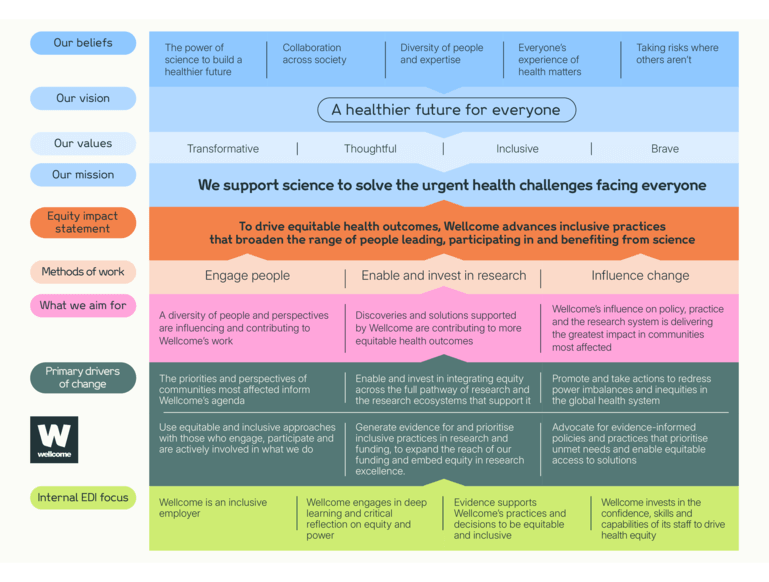
That is why we created Wellcome’s Equity Framework. It is a guide for all our work, from funding lab research to influencing global policy. Equity helps science focus on the discoveries that matter most for improving health and addressing unmet needs. To make that happen, we have to change how we look at three things: power, leadership, and communities.
Shifting the focus to power
When people talk about equity in research, they often just focus on representation - making sure different groups are included as participants in a study. While that matters, true equity requires us to look much more deeply at power.
Equity in research depends on who sets priorities, allocates resources, and contributes the knowledge that shapes solutions. World Health Organisation analysis of global biomedical research funding shows that low-income countries receive around 0.2% of grants awarded by major research funders, the lowest share of any income group. This highlights how little research investment flows to the settings where disease burden is often highest.
For too long, the global health system has kept power and funding in wealthy nations, while the rest of the world has often just been a place to gather data. To change this, we have to shift the "centre of gravity" in global health. The way science is funded right now naturally keeps decisions in the hands of a few. If we want science to benefit everyone, we have to change the balance of power. We must ask:
- Who sets the research agenda?
- Who controls the funding and resources?
- Whose knowledge actually counts?
An enabler of innovation and excellence
Shifting power creates the conditions for better science, bringing a wider range of expertise, perspectives, and insights into research.
Equity is how science becomes more relevant, more rigorous, and more capable of improving health outcomes for the people who need it most. The greatest scientific advances often come when different forms of expertise, lived experience, and unique perspectives come together to challenge old assumptions.
Opening research to new ways of thinking expands innovation and helps generate solutions that are more effective in the real world.
Centring people
At the heart of our framework is a simple rule: the priorities and perspectives of the communities most affected must inform Wellcome’s agenda.
People closest to a health challenge can often see dimensions of the problem that researchers and funders completely miss. They also understand how solutions will, or won’t, work in everyday settings.
We are putting this into action in our Mental Health programme, where we require lived experience to be central to the science we fund. This means people who have personally dealt with challenges like anxiety, depression, or psychosis are treated as equal partners in the research team.
People with lived experience help shape our work from day one, informing everything from funding design to project selection. Wellcome works with a global team of Lived Experience Advisors across the UK, Kenya, India, and other countries to help design our funding and choose which projects get supported. Through our Innovation Fund, we also partner with local organisations like Sangath in India to build national networks of young people with lived experience, making sure they can guide the mental health research happening in their own communities.
Engaging with the public and working in partnership with communities is a vital part of conducting robust, credible research. When the people experiencing a health crisis help guide the science, the results are much more trusted, relevant, and useful.
Who leads and who participates
To make this happen, we must invest in local research environments so they can lead the way.
Our support for the DELTAS Africa initiative is a clear example of this approach. DELTAS supports African-led research networks across more than 50 centres. This is not a charitable exercise; it is an excellence-based approach to science. Those working closest to a challenge often bring critical contextual knowledge, long-term institutional strength, and a deep understanding of community priorities.
We apply this same focus in the UK. Our Institutional Funding for Research culture helps UK universities strengthen collaboration and embed research culture change, supporting research leadership and successful careers.
By backing local scientists to set their own agendas and train the next generation of experts, we ensure that science creates sustainable solutions designed for the realities of people’s lives.
Driving real benefits
Equity is the link between scientific discovery and real-world impact. It helps ensure that innovation is not only advanced, but also accessible, affordable, and relevant to different contexts. Without it, the advantages of science stay out of reach for the people who need them most.
For Wellcome, this means supporting science that is shaped by the people whose health has the most to gain, while investing in the research systems and capabilities that sustain discovery. It also means addressing barriers to access - whether in funding, infrastructure, technology, or the translation of research into policy and practice. By generating evidence and embedding equity as a core dimension of research excellence, Wellcome can help ensure that the benefits of science reach everyone, particularly those who have been left furthest behind.

