How are diet, food and climate change connected?
Climate change is driven by and impacts the world’s food systems. It’s a vicious cycle and one that’s harming human health. But, changing how we produce our food – as well as what we eat – could help protect our planet and our health.
Credit:
Licence: All Rights ReservedAnadolu Agency / Contributor via Getty Images
Elapsed time:00:00Total time:00:00
Summary
Diet, food systems and climate change
- Our current food systems are responsible for more than one-third of global greenhouse gas emissions.
- In turn, climate change impacts our food systems and health – from making it harder to produce food to reducing the nutrients in what we eat.
- The world needs to take action to create sustainable food production processes, eat healthier and invest in fair, science-based solutions.
How are climate change and food systems impacting each other?
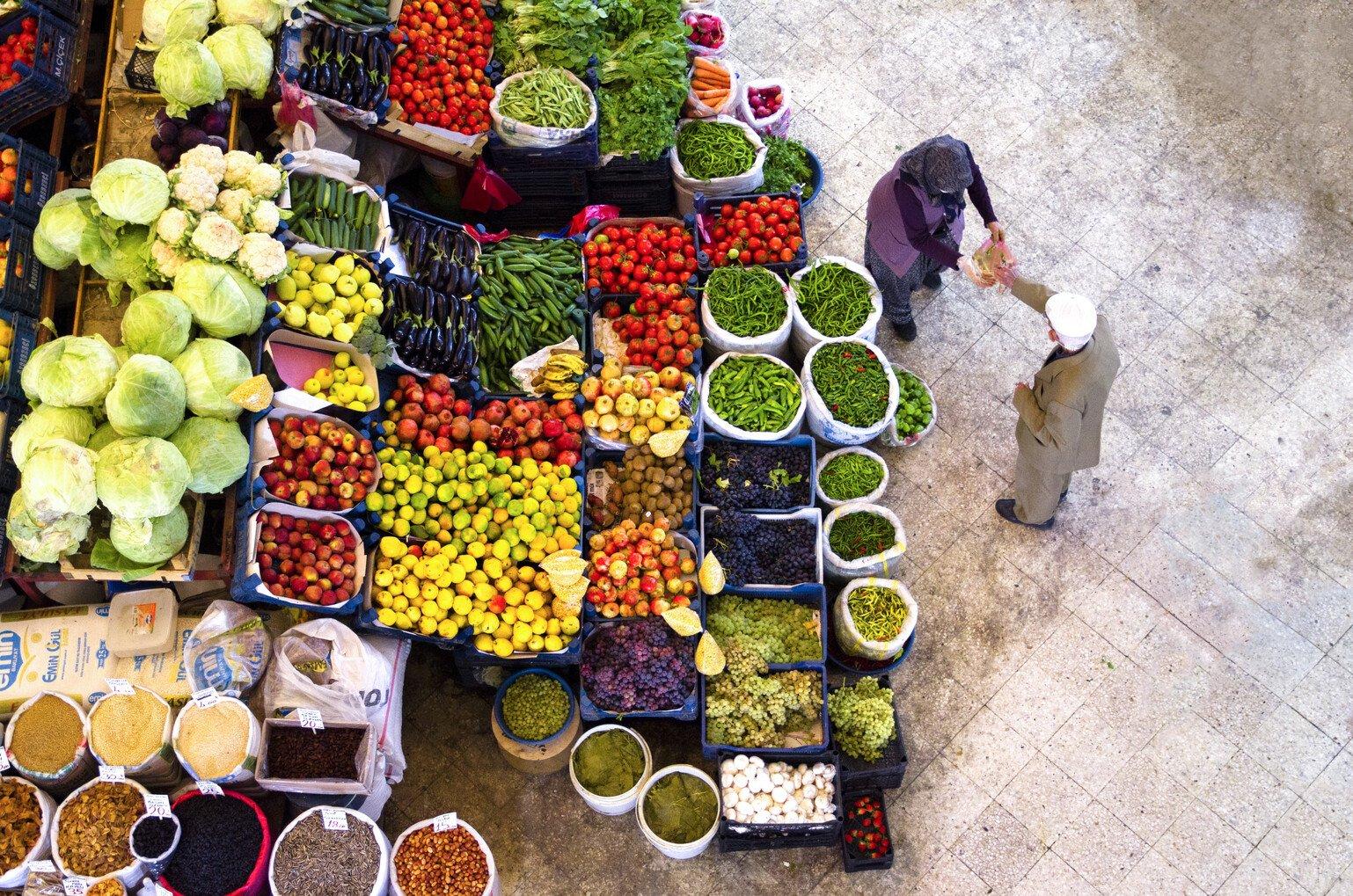
Food systems are the activities that take food from where it’s produced to people’s mouths. That includes how we produce, process, transport, market and consume food.
Our current food systems produce more than one-third of global greenhouse gas emissions – the main driver of climate change.
More than half of the food systems’ greenhouse gas emissions originate from the demand for meat and dairy, especially among high consumers of these foods. It’s also a result of modern industrial agriculture, which is highly dependent on fossil fuels.
In turn, greenhouse gases and climate change are impacting our food systems and our health. How?
Climate change is making it harder to produce food
Globally, despite huge advances in food production, crop yields are being impacted by climate change. And the effects of global heating on food production are not being felt equally.
In some parts of the world yields of vital crops are suffering whereas others seem to be benefitting. How this will develop is very hard to predict. And the ability of governments to shield food systems and the people who rely on them from the effects of climate change will be a key factor.
But everywhere more frequent extreme weather events are a growing threat to food production. Following an El Niño, in 2023/24, countries in southern Africa have been experiencing drought that led to a decline in maize production, threatening food security. This has had long-lasting impacts on the countries affected.
Meanwhile, extreme wet weather in the UK in 2026 left farmland and horticultural businesses under water. And floods following Storm Babet in 2023 submerged entire fields, ruining crops.
Globally, one in five deaths are attributable to poor diets caused by low consumption of healthy foods such as whole grains, fruits and vegetables. Climate change will reduce the yields of these foods and put more people's health at risk.
Climate change is reducing the nutrients in what we eat
The sixth assessment report from the UN Intergovernmental Panel on Climate Change (IPCC) highlighted that rising CO2 levels in the atmosphere will reduce the nutritional quality of our food. That includes protein, iron, zinc, and some vitamins in grains, fruits and vegetables.
Without these nutrients, more people will be at risk of micronutrient deficiencies, leading to serious physical and mental health consequences.
A systematic review of evidence found that reducing our vegetable intake could increase the risk of noncommunicable diseases, such as coronary heart disease and stroke and different types of cancers. Also, malnutrition impacts our bodies’ immune responses to infections, increasing the risk of infectious diseases.
Climate change is contributing to food shortages and higher food prices
Inequities in the food system are inextricably linked to poor diet and health. Globally around 2.6 billion people could not afford a healthy diet in 2024. And more than a quarter of the world's population faced food insecurity in 2022.
These issues will be exacerbated by climate change making it harder to produce food. With food shortages, food prices will increase, putting more people at risk of food and nutrition insecurity, chronic hunger and loss of livelihoods. Food shortages driven by climate change will also affect countries that rely heavily on imported food, for example the UK’s supply of fruit and vegetables.
These are just a few of the existing and future impacts.
What can be done to protect our planet and our health?
To protect people’s health and create a healthier planet, we need to act now to adapt to and mitigate climate change.
Here are three strategies that could help:
1. Adopt policies to help the world eat more healthily
Enabling large numbers of people to eat healthier diets can help fight the climate crisis.
Meat and dairy products have some of the largest climate impacts, and it’s projected that demand for these foods will grow by 68 percent over the next three decades.
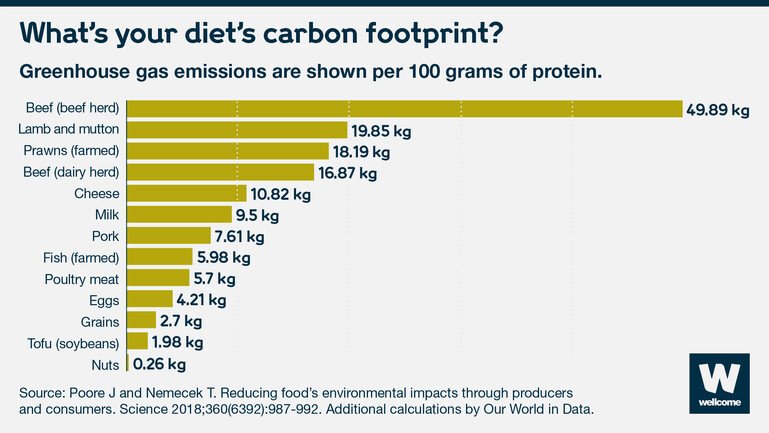
Greenhouse gas emissions are shown per 100 grams of protein across a global sample of 38,700 commercially viable farms in 119 countries. Greenhouse gas emissions are measured in kilograms of carbon dioxide equivalents (kgCO₂eq) per 100 grams of protein.
Source: https://ourworldindata.org/grapher/ghg-per-protein-poore
Credit:
Licence: Attribution CC BYWellcome
If regions with diets high in calories and animal-sourced food eat more plant-based foods, it will significantly help lower emissions, reduce mortality from diet-related risks and improve health.
What’s more, there are 14,000 existing edible plant species with excellent nutritional profiles that we could tap into. But we currently use less than 200. Growing a wider variety of crops, with different tolerances and strengths, will also help to protect our food from floods, droughts and diseases.
2. Encourage sustainable agriculture and food practices
There are several opportunities to make agriculture and food processes more climate resilient.
One intervention is improving soil quality. Healthy soil stores carbon and can reduce emissions. It also aids drought and flood management and increases crop productivity and resilience.
Another example is selecting crop varieties that are high in nutritional quality and more resilient in extreme climate and weather events. Diversification – growing a wider variety – could complement actions to improve dietary diversity.
Meanwhile, cutting food loss and waste can help reduce hunger and save energy and water. Around 17 percent of all food worldwide goes to waste every year – and food waste is responsible for around 8-10 percent of global greenhouse gas emissions.
3. Increase investment in fair, science-based solutions
The effects of the climate crisis are not equally felt. The countries least responsible for it are the most vulnerable to its impacts and have fewer resources to act.
It’s critical that rich countries, who are the most responsible, step up and lead the transformation of our food systems in the mitigation of climate change. They should also support lower-income countries with the necessary finance and technology to adapt to more sustainable and climate-resilient local food production.
The world must take substantial, timely action now to cut greenhouse gas emissions and support a transition towards climate-resilient food systems.
More collaboration and investment are vital, and our actions must be backed by science if we are to avoid the worst-case scenarios of climate change and its impact on our health.
That’s why Wellcome is supporting research to urgently generate evidence through programmes such as The Sustainable & Healthy Food Systems — Southern Africa Programme (SHEFS-SA), a project looking to understand the full cost of our diets across health, economic and environmental impacts and a study to uncover barriers to and enablers of a transition to positive health-centred net-zero-aligned food systems. Because having better evidence on the nature of the problem and solutions will make us better placed to build a healthy, sustainable future for all.
This article was first published 7 June 2022.
Tags