
Preserving the past to support people with sickle cell
Decades of community action and advocacy documented in the Sickle Cell Society archive have been preserved and made accessible by Wellcome Collection.

Credit:
Wellcome
8-minute read
8-minute read
Elapsed time:00:00Total time:00:00
Laurel Brumant-Palmer laughs as she picks up a black-and-white photo of four young women in an office, industrious among 1980s teak desks and shelves of lever-arch files.
“This is my little sister!” she exclaims. Alongside, she spies a pamphlet with a picture of herself in a hospital bed, receiving a blood transfusion around the age of 18. “It’s so surreal. I’m looking at history and I’m thinking, wow, I’m part of that.”
Laurel is exploring the Sickle Cell Society archive, a collection of over 300 items in 29 boxes, including photographs, annual reports, newsletters, fundraising and awareness campaigns – which came to Wellcome Collection in 2019.
Laurel is looking back on history. She’s also looking at a testament to community leadership, activism, lived experience, and campaigning for better care that lives on today.
Watch: How the Sickle Cell Society archive keeps community history alive
Pressing play on the video above will set a third-party cookie. Please read our cookie policy for more information.
This video explores the work done by Wellcome Collection to catalogue, preserve and make the Sickle Cell Society archive and make it accessible. It highlights how campaigners, patients and health workers recognise themselves in the story of a fight for health equity.
Elizabeth Anionwu
Sickle cell anaemia. You have probably heard these terms before but you and many of your friends and family may not know exactly what they mean.
Elizabeth Anionwu
I hadn't actually realised the wonderful, historical information that is available on film.
Elizabeth Anionwu
It's quite moving, actually.
Sonja Schwoll
The Wellcome Collection collect everything around health and the human experience. Our collection is made up of many, many thousands of objects, and each of these materials present a big challenge to really make sure that it lasts as long as possible. But at the same time can be accessed. In 2019, we acquired a really interesting archive from the Sickle Cell Society, a lot of pamphlets and notes, printouts and film material. The archive of the Sickle Cell Society is really important for public health here in the UK. Now that the Sickle Cell Archive is here at the Wellcome Collection, it guarantees that this archive is alive, is kept safe and is accessible to their community.
Elizabeth Anionwu
Oh, this is the very first newsletter. That was in September 1980, 46 years ago, really? Goodness me. I was one of the founder members of the Sickle Cell Society, the charity devoted to providing information and support to those affected by the condition.
Laurel Brumant-Palmer
My sister, this is my little sister. My parents, they were part of the Windrush generation. I had never heard of sickle cell at all. And Sickle Cell Society was amazing.
Elizabeth Anionwu
Sickle cell anaemia tends to affect predominantly the non-white community.
Rachel Simpson
Do you know what's funny? If this is the same office, it still looks like this. I currently work for the Sickle Cell Society. I think for my mum, I'm glad that she was able to find the community of advocates fighting for change and involved me in that.
Jacqueline Simpson
It was fantastic. It shows you a community that was there for you, for your child, that understood what you were going through.
Rachel Simpson
It was nice to see that and for my mum to experience that history as well.
Elizabeth Anionwu
Oh this is lovely, really lovely, the children's party in 1985. Look at that.
Laurel Brumant-Palmer
I think that's the only photo that I've actually seen of me having a blood transfusion. In that photo, I must have been, I'd say, 18.
Jacqueline Simpson
It's just reminded me of Alice and Rachel when they were babies.
Rachel Simpson
It's crazy to see how far we've come without all the work that they put in. I don't think my care would be as good. So I think for me it's kind of exploring that.
Laurel Brumant-Palmer
We fought for blood transfusions, and it's amazing when I see this picture, because it was one of the reasons why I have a life. What the Wellcome Collection actually has here is absolutely fantastic. Preserving history for the future to come.
Sonja Schwoll
We want as many people as possible to see these objects and not just at the Wellcome Collection. You can also access our collections online, and that's part of our work to organise these items so they can go to exhibitions or events or anywhere offsite. It's really what Wellcome is about.
Alinta Sara
This exhibition has been curated at the Royal London Hospital, using material from the Wellcome Collection and the Black Cultural Archive to raise greater awareness among staff about sickle cell.
Exhibition visitor
It's linked to present day situation and we can see what has evolved, what has improved, what hasn't been improved.
Exhibition visitor
It was great actually, I was really inspired. I think expression is so important when you have this condition, like it's the difference between health and wellness and sickness and pain.
Exhibition visitor 2
My daughter, she has sickle cell, so it's good for her to get more education.
Alinta Sara
I think it's a powerful history because it shows it comes from the grassroots organisation and changes come from like advocating and activism.
Elizabeth Anionwu
The Wellcome Collection does need to be congratulated. I'm delighted that it's taken on this project. This is a major organisation who has taken the trouble to collect our memories. If we don't have archives such as this, it will be lost. It will be lost to history.
Jacqueline Simpson
And I think historically, just seeing that we're not forgotten. It's important that we're not forgotten.
Sickle cell disease: raising awareness, improving care
Sickle cell disease is a serious inherited blood disorder which affects around 7.74 million people globally. It causes red blood cells to become distorted into a crescent or banana shape – their resemblance to a sickle gives the condition its name. These cells can block blood flow and cause extreme pain and life-threatening complications.
The disease is particularly common in people of African, Mediterranean, Middle Eastern, and Indian descent. People living with sickle cell disease need treatment throughout their lives and often face unequal care.
The Sickle Cell Society was set up in 1979 as a national charity to support people living with the condition. The Society's archive tells a story of care, courage and collective action across its work and through the decades – to raise awareness, tackle stigma and ensure equality of care for those affected.
Laurel, who was born in 1963, was three years old when diagnosed.
“Very little was known about sickle cell,” she says. “It was very daunting.”
Elizabeth Anionwu, the UK's first specialist sickle cell nurse, co-founded the Sickle Cell Society. The priority for the Society's early work was educating the public and national health professionals.
“This one is particularly special for me” she says, looking back at one of the newsletters now held in the archive at Wellcome Collection.
“A group of us were involved in putting together what we realised was needed, particularly within the health service, but in other agencies as well. We set out, I think it was 26 examples of where services needed to be improved.”
Community action and change
“We worked fast and furiously in producing the information that people were asking for,” Elizabeth remembers.
“We knew from the American experience that information – clear information – was so important. We deliberately wanted to portray the images of those mainly impacted. It affects a marginalised minority community,” Elizabeth says. “It’s important for that community to know that they’re recognised.”
The archive captures decades of progress in care and awareness.
“You forget how much was achieved by so many different people,” Elizabeth reflects. “Things have definitely improved. There is greater awareness. There are more services up and down the country provided through the NHS. I think one of the major achievements is that all newborn babies are screened for this condition, alongside the Guthrie test – the heel prick test. Life expectation has improved.”
Laurel is living proof of those achievements. “When the Sickle Cell Society came into our life – it was a fantastic support network for us, being that it was such a rare condition in those days. We fought for blood transfusions, and it was one of the reasons why I actually had a life.”
Keeping history alive
Wellcome Collection undertook a two-year programme to stabilise, preserve, and catalogue the Society's extensive archive, improving access both for members of the Society and wider audiences.
“By safeguarding these materials for the long term, we enable younger generations to encounter this history first-hand – learning from their predecessors and shaping the Society anew,” says Sonja Schwoll, Head of Conservation and Collections Care at Wellcome Collection.
The project was also supported with funding from the Heritage Lottery Fund and in collaboration with University College London.
Rachel Simpson, Communications Officer at Sickle Cell Society, has personal experience of sickle cell complications. She sees the history of the Society depicted in the archives: an evolving effort to improve lives.
“It’s not a destination – it’s literally a journey that we’re on,” she says. “I think it’s very important to be able to have access to that, for people to know it’s here and for people to know that we're still on that journey, and that is important.”
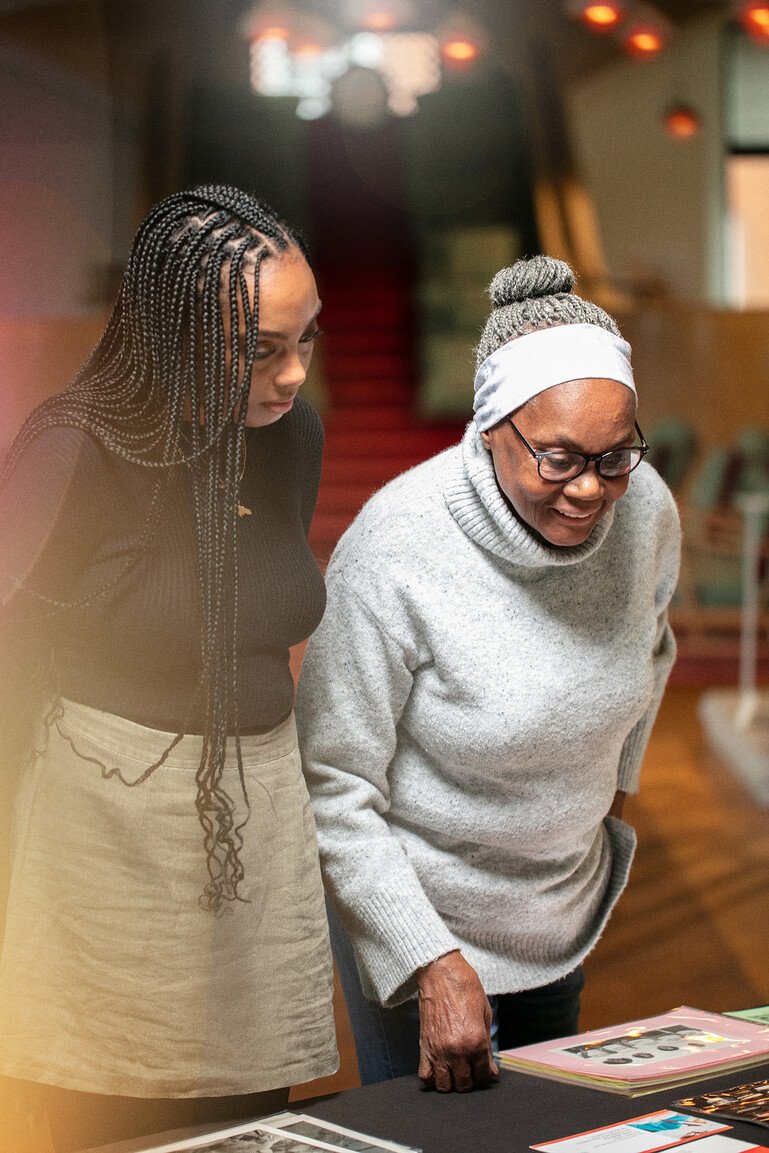
Rachel Simpson currently works for the Sickle Cell Society and has personal experience of sickle cell complications. Her mother, Jacqueline, became involved with the Society when Rachel was a child.
Helping people today
In 2026, the society and The Royal London Hospital organised an exhibition titled Our Story, Our Journey, featuring material from the archive.
It was created to raise awareness among staff, especially non-specialists who may treat patients with sickle cell disease.
“It’s a powerful history,” says Alinta Sara, curator of the Our Story, Our Journey. “It shows that change comes from the grassroots organisation... from advocating and activism.”
“The word that comes into my head is preserving – preserving history – and having history here for yesterday, today, and for the future to come,” says Laurel.
Tags

