
Gene therapy: changing the future for people with rare diseases
For people and families affected by some rare inherited conditions, gene therapy is beginning to change what is possible. It is the result of decades of research, careful clinical work and long-term scientific commitment.

Credit:
Licence: All Rights ReservedWellcome
10-minute read
10-minute read
Elapsed time:00:00Total time:00:00
A young life transformed
“It felt so far out of reach. For so long, it felt like an impossible dream,” says 20-year-old Remi Pereszczak. “It’s crazy to think that this is my life now.”
For Remi, the treatment he received as part of a clinical trial at Great Ormond Street Hospital (GOSH) changed everything. Before then, much of his childhood had been shaped and limited by immune deficiency disease.
Regular hospital visits, frequent treatment and daily pain were part of life with p47 chronic granulomatous disease (CGD). As Remi got older, the restrictions tightened. He couldn’t play outside, build friendships or live like other teenagers.
Today, things look very different. Since having gene therapy in 2024, Remi has finished his A-levels and started university. He has built relationships he once thought impossible.
“I feel like a normal person,” he says. “It’s a big change, a big step in my life.”
Watch: How gene therapy changed Remi’s life
Pressing play on the video above will set a third-party cookie. Please read our cookie policy for more information.
Claire Booth
Patients who come to see our team here at Great Ormond Street, often they've got very limited options for treatment. But we've now got gene therapies that are safe, that are effective, and actually they're curative, which is fantastic because these amazing therapies, which were just dreams 30 years ago, are now reality.
Remi
My name is Remi. I'm 20 years old. I live with my mum and dad and my sister. I was always the shortest and the youngest. Now I'm the youngest but second tallest. So when my mum usually needed something from the high shelves, she'd call my dad, but now she calls me. I got diagnosed at two years old with a very rare, extreme genetic condition named CGD. Chronic granulomatous disease.
Nadine
Remi is amazing. He's so bubbly and so fun, and has just so much energy, and it just sort of gives off that energy to other people as well. I feel like he doesn't recognise the hardship he's faced as much as he has, but I think the people around him who know what he's been through, they do.
Remi
CGD weakens your immune system. I've been in and out of hospitals for most of my life. Doctors said I can't do anything. I can't play in the woods, I can't play in the sand. Essentially, the best thing is not to do anything. I felt very different to other children my age. I had to take time off school. It affected my social life incredibly. I actually had no friends. I feel like I was missing out a lot.
Claire Booth
Immune deficiency disorders like Remi's, it's a faulty gene in the bone marrow. Patients who have CGD, they're really at risk of developing very severe bacterial and fungal infections. Patients can die of the infections that they get.
Remi
Most of my childhood, I managed my condition with antibiotics up until the age of 16, where it kind of deteriorated. I developed fungal infections in my lungs, inflammatory bowel disease and then a bone infection. I got admitted to Great Ormond Street Hospital.
Claire Booth
Historically, the treatment for immune system disorders like Remi's was a bone marrow transplant. But the outcomes from bone marrow transplant often weren't very good. And so here at Great Ormond Street, we're exploring gene therapy. Gene therapy is modifying a person's genes to treat or cure a disease. In Remi's case, giving a patient a new immune system. The gene therapy field began in immune deficiency disorders about 30 years or so ago, actually, here at Great Ormond Street and other centres. That technology has enabled new treatments for cancers and has allowed gene therapy to expand into many, many other different disease areas. A lot of the Wellcome Trust funding that we've benefitted from has been what we call preclinical studies. The bench work of finding a problem, developing a gene therapy for it and then taking it up to the point it looks safe enough and efficient enough to move into a clinical trial. So the trial that Remi was part of, it's a new trial that opened a couple of years ago. It was using techniques that we've used before, but it was the first time that this had been applied to the disease that Remi has. So we asked Remi to basically be the first patient in the world to receive this new treatment. And so we have to acknowledge that the families are putting a huge amount of trust into us.
Remi
My parents and sister were nervous for me, though they just sat there looking at me getting injections, and I just sat there on my phone in my own little bubble. I thought at least there is some kind of hope. After my treatment, straight away when I got home, I definitely felt better. There's no gut symptoms. I gained an insane amount of kilos. I feel like a normal person. It changed my life. I managed to do my A-levels, got into university. My parents are very proud of me. I've got friends now, really good friends, really close friends. I managed to get myself a girlfriend, my lovely girlfriend, Nadine.
Remi
Hi! How are you?
Nadine
Not too bad, thank you.
Claire Booth
But you look really well.
Remi
Yeah, I feel much better to be honest.
Claire Booth
Yeah, definitely – like your face, your skin, everything – just, you really look well. Remi had his gene therapy 18 months ago. He's off pretty much all of the medications that he was on beforehand. I think we would be confident to say that it has worked in his case, and that's amazing.
Claire Booth
All right. We will see you next month. Take care.
Remi
Take care. Thank you. Alright then, bye!
Claire Booth
The Wellcome Trust contribution to gene therapy has been enormous. Investing in scientists to make sure that we can continue to develop new cures. These amazing therapies, which were just dreams 30 years ago, are now reality for quite a lot of patients.
Remi
Going through what I've been through, it definitely taught me never give up and always have positive hope.
Claire Booth
We're still recruiting patients for the trial that Remi was treated on. Our hope is that that would become a treatment that was available for all patients with this condition around the world.
The challenge of rare genetic diseases
Rare genetic conditions may be individually uncommon, but it is estimated that together they affect hundreds of millions of people worldwide. Often emerging in childhood, they can shape every aspect of life – from school and friendships to a person’s independence.
Remi has p47 chronic granulomatous disease (CGD), a condition that weakens the immune system. People with CGD are therefore vulnerable to serious illness.
“CGD is a life-threatening disorder,” says Claire Booth, professor of paediatric immunology and gene therapy at Great Ormond Street Hospital, who led Remi’s care and the clinical trial he took part in. “Patients often have very limited treatment options.”
Historically, treatment has been difficult. Bone marrow transplants can offer a cure, but suitable donors are not always available and outcomes have not always been reliable. For many, the reality has been lifelong management rather than recovery.
How does gene therapy work in CGD?
Gene therapy is designed to treat disease by correcting the genetic problem, rather than managing symptoms. The benefits can be life-changing, offering long-term health improvements in place of frequent, short-term and less effective treatments.
In Remi’s case, doctors at GOSH used a type of gene therapy called ex vivo treatment. They took some of his blood stem cells – the cells that make the immune system – and corrected them in the lab using a modified virus to deliver the working gene. The corrected cells were then returned to his body, where they could begin rebuilding his immune system.
“If we can correct those [blood stem cells], the idea is that we’ll be able to give that patient a working immune system that will last them for the rest of their life,” says Claire.
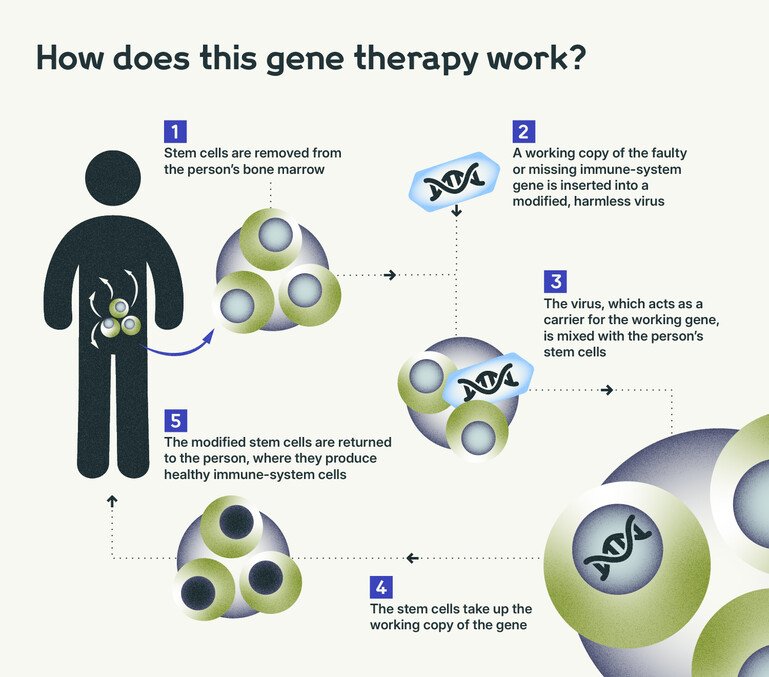
This ex vivo gene therapy uses modified stem cells to deliver a working copy of a faulty gene and rebuild the immune system.
Credit:
Licence: All Rights ReservedWellcome
The origins of gene therapy for CGD
The treatment that Remi received has been decades in the making. Early breakthroughs came from research into rare immune disorders, where researchers learned how to insert working genes into blood stem cells and make those changes last.
Adrian Thrasher was one of the key figures in that work. Over many years as Professor of Paediatric Immunology at University College London and GOSH, he helped pioneer gene therapy for inherited immune disorders and bring it into clinical use. He and Bobby Gaspar were part of the team at GOSH that treated the first child in the UK with gene therapy in 2001.
Adrian’s work was supported by Wellcome from the early 1990s onwards, helping sustain the long-term research needed to develop these approaches. His first Wellcome fellowship supported the development of gene therapy for p47 CGD – Remi’s condition.
As Claire says, simply showing that this could be done at all was crucial: “That was really the first step. Being able to actually put a gene in a person’s DNA and that gene worked.”
This breakthrough laid the foundations for the gene therapies used today, including treatments like the one that changed Remi’s life.
From research to real-world impact
For Remi, the shift from research to treatment is life-changing. He was the first patient in the world to receive this particular gene therapy for his condition, as part of the trial led by Claire and her team. The ongoing clinical trial, along with the development and preclinical testing that made it possible, has been funded by the UCL Technology Fund, managed by AlbionVC in collaboration with UCL Business.
The effect on Remi’s life has been dramatic. “It’s a big, big change,” says Remi. “I can just live my life, reach my goals and pursue what the future has to hold.” This change is felt every day in simple moments. “For most people, going to the park or going to the sea is quite normal. But for me, it’s like a luxury now.”
The benefits extend beyond individual patients. For families, gene therapy can bring greater stability and reduce uncertainty. For healthcare systems, it opens up new ways to treat conditions that were once very difficult to manage.
And its influence reaches further still. As Claire explains, working in rare diseases often leads to wider breakthroughs:
“One of the best things is that whilst you’re working on diseases that are individually very rare, you can learn things that are transferable to other conditions, and importantly you can learn things that are transferable to common diseases as well.”
She adds that this is why the field matters so much: “Whilst it might only particularly treat a handful of patients with that condition, the implications and the ripple effect of treating and finding out about that condition can be huge.”
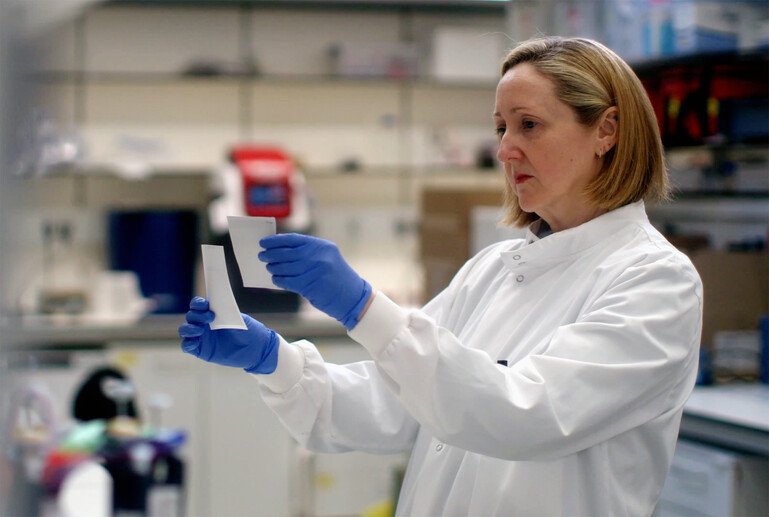
Professor Claire Booth led the clinical trial that gave Remi access to a pioneering gene therapy for CGD.
Credit:
Licence: All Rights ReservedWellcome
What’s next for gene therapy?
Despite important progress, challenges remain. One of the biggest is access. Even when therapies are shown to be safe and effective, making them widely available can be difficult – especially for ultra-rare conditions.
Cost is a significant barrier. Many gene therapies are expensive to develop and deliver, sometimes costing millions per treatment. They also require specialist facilities and expertise.
Researchers are exploring new approaches, including in vivo gene therapy, which could deliver treatment directly into the body and make it simpler and more scalable.
“The next step is making them available to more patients,” says Claire.
For Remi, the change already feels like a clear dividing line. “I would say like a second life, two separate lives to be honest,” he says.
For many others, that second life is still to come.
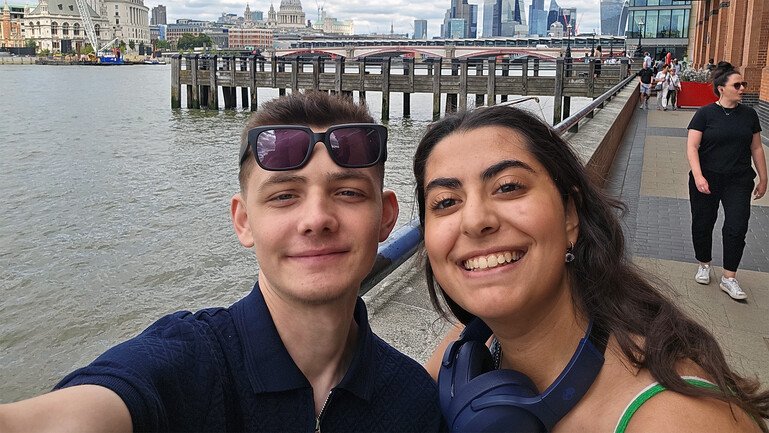
Since receiving gene therapy, Remi has built relationships he once thought impossible, including with his girlfriend, Nadine.
Credit:
Licence: All Rights ReservedWellcome
How Wellcome has supported gene therapy research
Over several decades, Wellcome has supported researchers developing gene- and genome-based approaches across many areas of health, including rare immune disorders, neurological conditions, blood cancers and inherited eye diseases.
Rare immune disorders
Wellcome fellowships supported Adrian Thrasher’s research from the 1990s onwards, including work on gene therapy for p47 CGD. Wellcome also provided early- and mid-career funding for gene therapy research to Claire Booth, helping her build expertise behind later trials in gene therapy for rare immune diseases.
Neurological conditions
Sarah Tabrizi’s Wellcome-funded research has explored gene-silencing approaches for Huntington’s disease, with the aim of developing treatments that target the underlying cause of this progressive inherited condition.
Blood cancers
Support from Wellcome has contributed to Waseem Qasim’s work on edited T cells for acute myeloid leukaemia, exploring new ways to treat this high-risk disease using modified immune cells.
Inherited eye diseases
James Bainbridge’s work on inherited retinal diseases, including the first clinical trial for gene therapy in this area, was partly supported through Wellcome fellowships. More recently, a Wellcome Discovery Award has supported Robert MacLaren’s CRISPR-based research into inherited retinal disease, aiming to advance new treatments towards clinical trials.
Tags

