
Mitochondrial donation: hope born thanks to pioneering treatment
The birth of healthy babies through mitochondrial donation came after decades of dedicated research and advocacy. It’s a remarkable story of how science can change the future for families affected by inherited disease.

Credit:
Licence: Attribution CC BYWellcome
11-minute read
11-minute read
“Mitochondrial donation is really important for families like ours, where it is a maternally inherited disease and daughters may pass on that disease. It gives children and their children the option of not passing on what can be a really, really cruel disease.”
Kat has two teenage daughters. The youngest, Poppy, lives with mitochondrial disease, an incurable, progressive condition.
In March 2015 the family were among thousands celebrating the UK becoming the first country in the world to legalise mitochondrial donation. It opened the way for clinical trials of the cutting-edge IVF technique developed by researchers at Newcastle University and the Newcastle upon Tyne Hospitals NHS Foundation Trust.
A decade later, in July 2025, the research team announced that eight babies, four boys and four girls, have been born through the technique – all are developing normally and not showing signs of having mitochondrial disease.
“That's amazing,” says Kat. “It’s given those families a choice where choice didn't exist before. They're now living with children who can live free of the disease and it's broken that cycle. It's brilliant.”
Watch: the science that gave families a new choice
Pressing play on the video above will set a third-party cookie. Please read our cookie policy for more information.
For families affected by mitochondrial disease, breaking the cycle of inheritance once seemed impossible. This film follows the scientists, families and policymakers who helped make the UK the first country to permit mitochondrial donation, leading to the birth of eight healthy babies.
Louise Hyslop
Ready to start. We'd see every single birth as a win for these women. It's giving them hope.
Doug Turnbull
I've always lived in Newcastle, very much a Geordie, and proud of it. My specialty is in mitochondrial disease. So mitochondria is a powerhouse of the cell. So it converts the food that we eat into a usable form of energy. Mitochondrial disease is where that breaks down. If your mitochondria are faulty, your cell starts to run out of energy, which can be truly devastating for some families.
Kat
I'm Kat, married to James. We've got two daughters, aged 15 and 17. The eldest is Lily, the youngest is Poppy, and she has a condition called mitochondrial disease. It is progressive, so she's lost a lot of function and needs 24/7 care. Mitochondrial disease is a maternally inherited disease and still a disease of which there is no cure.
Doug Turnbull
Having looked after patients with mitochondrial disease for about 20 years and really having very little to offer these patients, we came across the idea that maybe we could prevent the transmission. Mitochondria are passed down from mother to child. So the idea is that we take a donor woman's egg, we take out the nucleus of that egg, and we transfer in the nucleus from the parents. And that means that we'll have the nuclear DNA from the mother and the father, but the healthy mitochondria from the donor woman. And under those circumstances, we thought it was possible that we would have healthy babies with no risk of having mitochondrial disease. Having ideas is fine. To be able to actually make this really happen, you need support and funding, and that's where the Wellcome Trust came in. In 2011, we went for an interview at the Wellcome Trust, and I remember coming out of it thinking, hmm, I'm not sure, I'm not sure. And then later that night, the chief executive of Wellcome gave me a ring and said, well, we're not going to give you the grant. We're going to make you a Wellcome Centre. And it was totally out of the blue. It was totally transformational because not only did that give us enough money to do the work, but it also gave us access to all the brilliant people at Wellcome who could help us with all other aspects, whether it be in relationship to the ethics or the policy engagement.
Kat
To make mitochondrial donations available to families, the law needed to be changed. We were involved in that via the Lily Foundation, who are the charity that support families with mitochondrial disease. They were part of a wider working group along with the scientists, experts, Wellcome, who was an instrumental partner in pushing this whole thing through. We actually wrote to our local MP, who happened to be Jane Ellison, the member of parliament responsible for this bill.
Jane Ellison
I remember meeting Doug and the rest of the team and being so impressed by them. I mean, obviously, their huge brains and the brilliant science they've done. But also their humanity and their sense of mission. This is a bold step for Parliament to take, but it is a considered and informed step, and for the many families affected, this is light at the end of a very dark tunnel, and I commend these regulations to the House. The most extraordinary moment was actually when they announced the results in Parliament. I knew the gallery was full of families and I think some of the scientists and other people had been involved in this long journey to this moment.
Speaker of the House
Order! Order! The ayes to the right, 382. The noes to the left, 128.
Kat
It really is a moment in history and a kind of once in a lifetime moment to be part of something where, where law is changed for the sake of medical advancement.
Doug Turnbull
One of the most inspiring things about this, there's a lot of people working together towards a common goal.
Louise Hyslop
I have the donor and the patient's fertilised eggs in the dish, and I'm ready to start the procedure. People liken it to playing a computer game with joysticks. We have the microscope that have what we call micromanipulators, and attached to those we put very, very fine pipettes, and they allow us to do the biopsy procedure. So that's the first part done. The pronuclei have been removed from the donor fertilised egg. The donors come from the local area. These are women that just altruistically want to donate their eggs to help another couple. I'm now transferring from the patient's fertilised egg to the donor's fertilised egg. You're always thinking about the patient because you're looking at the embryos. Is it going to be good news? Is it going to be bad news? That's the transfer complete. When it is good news, you know, you can feel the warmth in the room. There are now eight babies born that have a very little lifetime risk of developing the disease. And if it hadn't been for the technique, those families couldn't have been created. In terms of young people that know they've actually got mitochondrial DNA disease, it gives them another reproductive option.
Kat
For families like ours where there are daughters who may pass on that disease, it's really reassuring to know that there is an option and there is choice.
Doug Turnbull
To have gone through the 25 years it took from the idea through to fruition and us able to report eight babies, it's just, it's just wonderful.
Louise Hyslop
You sort of pinch yourself to think, we've finally got to this stage. It's absolutely amazing to think that we've kind of spearheaded this, and that there are other countries like Australia now following suit.
Kat
So mitochondrial donation, in terms of breaking that inheritance cycle, it's fantastic. What I guess is still an absolute critical piece of work is research around treatments and cure for those living with mitochondrial disease now.
Doug Turnbull
I'm still working with others to try and find cures for mitochondrial disease. I spent 45 years of my life working on it. It's something that I'm still trying to help in whatever way that I can.
What is mitochondrial disease?
Mitochondria are tiny structures inside our cells that act like batteries, powering everything we do. Their work depends on instructions in both our main DNA and a small amount of special DNA carried by mitochondria. But when they don’t work properly, the results can be life-changing.
We inherit our mitochondria from our mothers. And if there are faults in the mitochondrial DNA, they can be passed on too. Mitochondrial DNA disease is the rare inherited condition caused by these faults. It can lead to severe disability and, in many cases, early death. There is no cure.
A lifetime’s work
Mitochondrial donation to prevent transmission of faulty mitochondrial DNA was pioneered in human eggs by a team based at Newcastle University, UK and the Newcastle upon Tyne Hospitals NHS Foundation Trust.
Research into the technique began in the early 1990s and represents almost a lifetime’s work for Sir Doug Turnbull, emeritus professor at Newcastle University, and his colleagues.
“I’ve looked after patients for many, many years. We would often see the grandmother, the mother and the child – and they’d all have mitochondrial disease. This is a genetic condition, and you’d expect this. But it did make me think: what about the inheritance, and could we do anything to prevent transmission?” Doug says.
“The experience that really sharpened my focus was a lady who lost six children in the first 48 hours of life. That’s what started the whole set of research – the whole domino effect – the whole process of mitochondrial donation.”
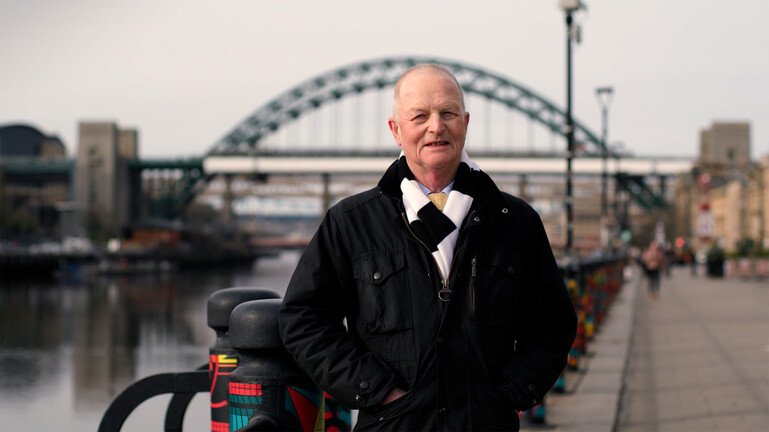
Sir Doug Turnbull, emeritus professor at Newcastle University, spent decades leading research into mitochondrial disease and helped pioneer the development of mitochondrial donation.
Credit:
Licence: Attribution CC BYWellcome
How does mitochondrial donation work?
Mitochondrial donation works by transferring the nucleus from the mother’s egg, which carries faulty mitochondrial DNA, into a donor egg that has healthy mitochondria.
“The early days were frustrating because the technique used for proof of concept didn’t simply translate to using normally fertilised eggs,” says Louise Hyslop, consultant embryologist at Newcastle upon Tyne Hospitals NHS Foundation Trust.
“That meant a lot of optimisation and troubleshooting to figure out how we could maximise the number of embryos that could form a pregnancy.”
The team found success with pronuclear transfer, where both the mother’s egg and donor egg are fertilised prior to the nuclear material being transferred from the mother’s egg to the donor egg.
“People liken the process to playing computer games with joysticks,” Louise says. “We have microscopes with very fine pipettes. Attached to those pipettes are air syringes that allow us to apply a very gentle amount of suction to be able to hold onto the fertilised egg and then remove the pronuclei.”
The result is an embryo with egg and sperm DNA from the parents and a tiny amount of mitochondrial DNA from the donor – less than 0.1 percent of the total genome.

Pronuclear transfer is a technique used as part of mitochondrial donation. The mother's egg containing unhealthy mitochondria and a donor egg containing healthy mitochondria are fertilised. The nuclear material from the mother's egg is transferred to the donor egg where the nuclear material has been removed. The result is an embryo with the parents' genetic material and the healthy mitochondria from the donor. Some unhealthy mitochondria can be transferred from the mother's egg during the procedure.
Credit:
Licence: Attribution CC BYWellcome
A fight for legislation
Alongside the success of the technique came complex ethical and legal questions. Could this be done safely? Should it be allowed? And how could public trust be earned?
“That started a totally separate journey from the science: engaging with politicians, the public, ethical reviews,” Doug recalls. “It was challenging at times, but also inspiring, the way people helped and were supportive.”
“I still remember the moment they announced it. I was in the public gallery at the Houses of Parliament. A huge cheer went up. I still get emotional thinking about it.”
Two years after the historic change in UK law, the team were given the first licence to carry out the treatment. That same year, the Human Fertilisation and Embryology Authority (HFEA) – the regulatory body – granted the first patient licences.
The treatment is offered as part of a range of options, with mothers and babies followed closely through early years.
Supporting science, shaping policy, building trust
The success of mitochondrial donation involved many organisations including Newcastle upon Tyne Hospitals NHS Foundation Trust, Newcastle University, National Institute for Health and Care Research Biomedical Research Centre, NHS England and patient charity the Lily Foundation.
Wellcome’s role spans discovery, clinical trials, public engagement, policy and regulatory change.
“It’s a remarkable example of scientific achievement and a powerful demonstration of the importance of science grounded in close and careful co-ordination between researchers, funders and regulators – and, very importantly, working closely with families affected,” says Beth Thompson, Executive Director, Policy & Partnerships at Wellcome.
Wellcome support contributed to several major milestones, including:
- funding the Wellcome Centre for Mitochondrial Research at Newcastle University, where the technique was developed
- supporting public engagement and communications, and ethical discussions to ensure the science was grounded in people’s real concerns and values
- working with policy makers, regulators and researchers to help shape the UK’s legal framework
- co-funding the clinical trial to assess the safety and effectiveness of the treatment
Those families – they’ve now got a genetically related child, they don’t have the fear of growing up thinking, am I going to develop the disease? It’s absolutely amazing to think we’ve spearheaded this and there are other countries following suit.
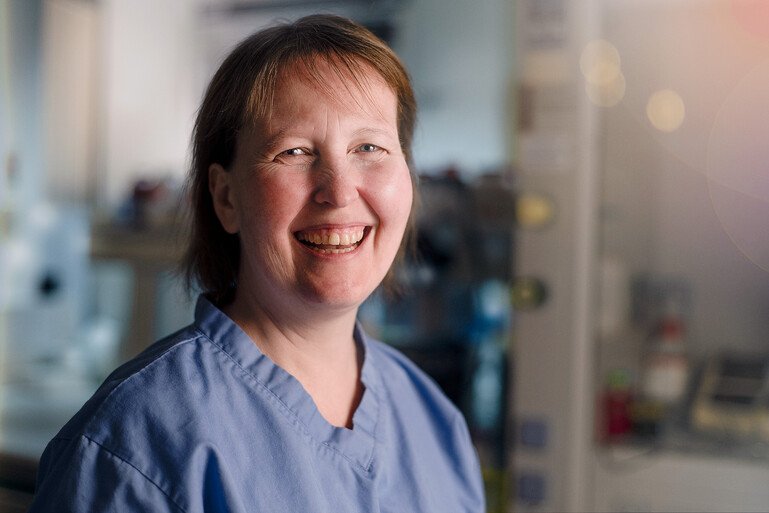
Louise Hyslop, consultant embryologist at Newcastle upon Tyne Hospitals NHS Foundation Trust, helped develop and refine the mitochondrial donation techniques that have enabled families affected by mitochondrial disease to have healthy children.
Credit:
Licence: Attribution CC BYWellcome
Does mitochondrial donation work?
The babies born are so far proving that mitochondrial donation works, and have been carefully monitored by a team led by Bobby McFarland, Consultant Paediatric Neurologist at Newcastle upon Tyne Hospitals NHS Foundation.
The team devised a programme geared around families’ existing interactions with health professionals, plus a formal developmental assessment at 18 months. A further longer-term follow up at around five years is currently under consideration.
All eight babies in the study published in 2025 hit their development milestones. And the mother’s disease-causing mitochondrial DNA mutations were either undetectable or present at levels that are very unlikely to cause disease.
“These couples often say to us, ‘you’ve given us something we couldn’t have possibly had otherwise.’ It’s so rewarding,” says Bobby.
Australia begins clinical trials
Mitochondrial donation demonstrates what’s possible when long-term support for science is in place. And it’s not just UK families who will benefit. Australia is now following suit by implementing legislative change and a clinical trial is underway.
Wellcome continues to fund a wide range of research into mitochondria and their connections to health, including mitochondrial disease. And we continue to push for policy to keep pace with scientific innovation across a range of emerging issues.
Tags

