
OPM-MEG: A revolution in brain imaging technology
A lightweight, 3D-printed wearable brain scanner promises extraordinary new insights into the human brain, transforming how we view neurological diseases and brain function, especially for young children and those with epilepsy.

Credit:
Licence: All Rights ReservedWellcome
12-minute read
12-minute read
“It’s such a cool piece of technology! It’s like having a cloud on your head. It’s really nice,” says Liberty.
Mum Rachel is watching 17-year-old daughter Liberty model what looks like a trendy cycle helmet covered in latticework and holes. On a screen Liberty’s brainwaves are tracked to the exact millisecond as she moves and talks.
This wearable technology is a far cry from the invasive intracranial scans Liberty needed after she was diagnosed with epilepsy at age four.
Watch: Building a brain scanner you can wear like a hat
Pressing play on the video above will set a third-party cookie. Please read our cookie policy for more information.
From invasive brain surgery to a lightweight wearable scanner. Follow Liberty's story and discover how Wellcome-funded researchers developed a technology that could transform brain imaging for children with epilepsy and beyond.
Gareth Barnes
The special thing about a portable brain scanner is that you can move around with it on. You can wear it like a helmet. I never imagined that this technology was possible. I always thought it was a pipe dream. I'd say this is a breakthrough that's changed the way we think about the brain and how the brain works. My name is Gareth Barnes and I study the brain and the spinal cord, the central nervous system. I've known Matt since he was an undergraduate student.
Matthew Brookes
I've always really enjoyed physics, and I found medical physics a way to use physics for something that's actually really important in the real world. Working with Gareth was always really enjoyable. When you're having fun with your friends in the lab, that's when you're at your most productive, I think.
Gareth Barnes
He provides a lot of the enthusiasm and I provide the age.
Matthew Brookes
MEG stands for magnetoencephalography. What we do is measure magnetic fields that are generated by currents that flow through the brain.
Gareth Barnes
The main clinical application is in planning epilepsy surgery. Often you get multiple seizures and there's one leading one. And you need to know to the millisecond which bit of the brain started the seizure before you operate. And you can plan the epilepsy surgery much more accurately. Take a seat. Thank you very much. Thank you.
Matthew Brookes
In traditional MEG, we use sensors called superconducting quantum interference devices. They're excellent. They're very, very sensitive to very small magnetic fields. But they have one key drawback, and that's that they need to be kept exceptionally cold to work, so -269 degrees. That obviously places a lot of limitations. You can't get them very close to the head because of the low temperatures. And they also need to be in a rigid helmet. So for example, if you move your head relative to the sensors, then that will blur the magnetic field that you're measuring. So scanning, for instance, children in a conventional scanner is very difficult because they move around.
Gareth Barnes
At the moment, the way that surgery is planned for children is actually through an invasive procedure, where often electrodes are implanted in the brain.
Liberty Jones
When I do horse riding it's just like my anxieties have just left my mind. So, my name is Liberty, I've been diagnosed with epilepsy.
Rachel Jones
You started having seizures at the age of four, and they started off as like a cramp in your leg. And the poor GP told you to eat more bananas because she thought you were low in potassium.
Liberty Jones
So, the amount of brain surgeries that I've had, up to now, would be — is it two, three?
Rachel Jones
I'm not sure you'd still be alive if you hadn't had the brain surgery, because, you know, Liberty was having 30 seizures a day. You know, the toughest bit actually was the diagnostic part, which was the intracranial EEG, where they were trying to find exactly where the lesion was, because that was ten days sitting in a bed with these long wires, you know, in her brain and all of those EEGs and MRIs and time off school and away from your friends, which I think really affects a child's life, actually.
Liberty Jones
I'm really excited about this new brain scanning thing. I think that if it was around when I was younger, it would definitely make my journey so much easier.
Gareth Barnes
We were lucky to get funded by the Wellcome Trust. Key to our story is this small piece of Lego, and what we were able to say to them was, we think we're going to be able to build an array of sensors about this size. That means we can put lots of the sensors all around the head in a helmet and measure people as they're moving around naturally. This was one of the first head casts that we made where we got lots of slots for sensors. And what we realised was any slight movement of those sensors really messed things up. And so what we've got, you can see the Velcro at the back that will stick the head to a bench. And Matt and his team would record from me as we stuck the one sensor into these 13 separate slots.
Matthew Brookes
And I remember you lying in there and you were like, bolted to the floor and you were drinking coffee through a straw. This was one of the first helmets that we used in children. So it is just a bike helmet. So we cut some slots in the bike helmet, put the sensors through the slots, and it was something that children were used to wearing. But when we tried to put enough holes in a bike helmet to hold sensors everywhere, it fell apart. So this was supposed to look like a bike helmet, was supposed to feel like a bike helmet for children. Then they can sort of move around freely and be scanned.
Gareth Barnes
The really good thing about the five years of funding from Wellcome is that it allowed us to be much more ambitious. Originally, we just intended to build something that might work, and then five years gave us the opportunity to build something that we were able to show actually did work and did work clinically. So at Young Epilepsy, they're doing very exciting work of scanning young children in collaboration with Great Ormond Street Hospital. And you can see how it would be a tremendous benefit to them, and it would be really amazing to know that we've done something to help them out.
Matthew Brookes
Right now, the technology is used in research. It's not used clinically because it requires medical device approval. We're working really hard on getting that medical device approval. Following that, it will be able to be used to influence clinical decisions.
Christine Embury
And here you go! Wow, Libby, look at that. Head back just a little bit. How does that feel?
Liberty Jones
It's really comfortable actually. Yeah. Really, really comfortable. It's like having a cloud on your head actually.
Christine Embury
Nice. And they're designed around bike helmets, so it is supposed to be really easy to wear and easy for people to use.
Rachel Jones
Imagine how this would have helped you, Libby, when you were having all your diagnostic stuff for your surgery. So Liberty had an intracranial EEG, and that was possibly the most invasive and traumatic part of the brain surgery. And I'm guessing this would have meant that she didn't have to have that.
Liberty Jones
I think that I would find this so much better.
Matthew Brookes
So if I were to go back 10 years and somebody could show me 10 years ago what we are doing now, I'd think it would look like science fiction, it really would. The idea that we can MEG scan people while they're stood up walking around. Yeah, it would have seemed like something from Star Trek.
Gareth Barnes
I think it was very brave of Wellcome to fund us. Especially when we came in with a Lego cube to start with, and they were taking a risk on us, and I'm very glad they did, and I'd say it certainly has paid off.
Matthew Brookes
I am excited for the future. I hope that in a few years' time we'll see patients starting to benefit and lives being changed based on the technology.
The world’s first portable brain scanner
“What we’re doing here is a world first. It’s a brain scanner you can wear. And that’s very different from a brain scan that’s typically a tube you get jammed into. It has changed the way we think about the brain and how the brain works, and it’s allowed us to scan the brain in its natural environment. It’s a big breakthrough for neuroscience.”
Gareth Barnes, head of magnetoencephalography at University College London, has spent the last decade working with Nottingham University’s head of physics Matt Brookes. Together, they have been developing the optically pumped magnetometer-magnetoencephalography (OPM-MEG): a wearable brain scanner. Initially aimed at children with epilepsy, it also comes with a remarkable number of unprecedented potential applications across medicine, military and sport.
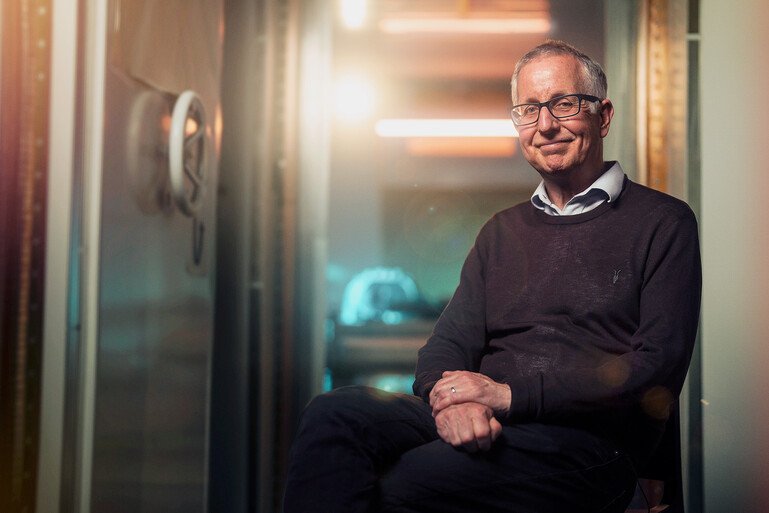
Gareth Barnes, Head of Magnetoencephalography at University College London, helped lead the development of OPM-MEG, the world's first wearable brain scanner.
Credit:
Licence: Attribution CC BYWellcome
It was developed as an alternative for invasive, intracranial electroencephalograms (EEGs) and traditional magnetoencephalography (MEG), which Gareth describes as "a very big one-size-fits-all thermos flask into which everybody’s head has to fit".
Traditional MEG requires cryogenic conditions of minus 269°C for the magnetic field detectors to operate.
“That places a lot of limitations. You can't get them very close to the head because of the low temperature, so they have to be kept a relatively long way away. They have to be kept behind a vacuum, again for thermal insulation, and they also need to be in a rigid shell,” says Matt.
If a patient moves their head, it blurs the magnetic field. For children, whose smaller heads are proportionally further away from the sensors, there is even lower sensitivity. And of course, it’s very difficult for children to stay still throughout the entire process. MEGs are also extremely expensive to buy and run.
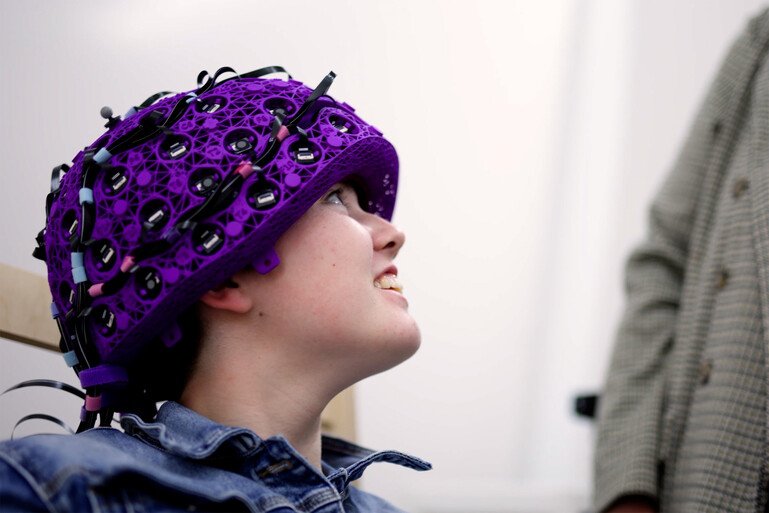
Liberty wears the OPM-MEG scanner during testing. The lightweight wearable system was designed to make brain imaging more accessible, particularly for children and people with epilepsy.
Credit:
Licence: Attribution CC BYWellcome
“Epilepsy is a tough gig,” says mum Rachel. By the time Liberty was seven she was having 30 seizures a day. Rachel recalls: “The toughest bit was the diagnostic part – the intracranial EEG – where they were trying to find exactly where the lesion was. They take a piece of skull off, and wire into the brain. That was probably the hardest bit: ten days sitting in a bed with these long wires in her brain, reading the EEG results and testing all the time. That was a lot to go through.”
Small, portable and flexible: A new generation of sensors
The technology behind OPM-MEG has an unexpected origin. In the early 2000s, US scientists were working on making atomic clocks smaller, cheaper and more widely available. They discovered they could use atomic clock components to measure very small magnetic fields from the brain. It was an important step towards a new generation of super-precise measurement devices called quantum sensors that could operate without cryogenic temperatures. This meant they had the potential to become small, portable and flexible.
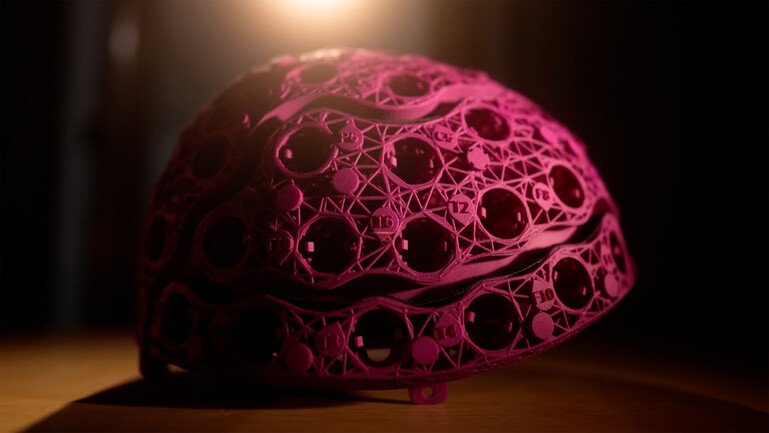
The custom 3D-printed OPM-MEG helmet holds quantum sensors close to the head, enabling highly detailed measurements of brain activity without requiring people to remain still.
Credit:
Licence: Attribution CC BYWellcome
That potential drew the attention of Matt and Gareth. “My team did some simulations on what might be possible and the results were so exciting we went to London and took the results to Gareth. He was very excited too, and that's how we got started,” says Matt.
In 2025 the pair were ready to unveil their wearable scanner to the world. It’s a piece of engineering brilliance – sensors not much larger than a thumbnail in holes around a 3D-printed helmet that can be scaled to fit babies, children and adults. Each sensor is meticulously wired into a backpack worn by the patient inside a magnetically shielded room. People are free to move naturally as the brain scan takes place. It’s remarkably precise due to the sensors’ proximity to the brain.
Treating epilepsy earlier, or operating earlier, would be a big advantage to these children. That's what this technology might allow. I think it will offer enormous hope.
Further development and regulatory approval is needed before the wearable scanners can move beyond specialist centres into wider use, but the clinical potential is significant.
“This technology is potentially most impactful on children,“ Gareth says. “Children not only have small heads, but they also find it difficult to stay still within a conventional scanner. For that reason, children are often not scanned until they're about 18 years old, which can mean they don't get their surgery until they are adults, by which time their education is finished.
“Treating epilepsy earlier, or operating earlier, would be a big advantage to these children, and that's what this technology might allow."
“I think it will offer enormous hope because it’s such a slow process otherwise: doing all the diagnostic tests, waiting for results, the results aren’t clear, so it’s back to the drawing board. It’s a really long process. Anything that can speed that up will be amazing,” says Rachel.
Wellcome: long-term commitment propels scanner from prototype to patients
In 2016, armed with a toy building block to show Wellcome the size of the sensors they wanted to achieve, Gareth and Matt applied for funding. Wellcome awarded them a five-year collaborative grant.
“That longevity of funding enabled us to get from an initial prototype to where we are now, which is something that can actually be used routinely for neuroscientific discovery,” says Gareth.
Additional support from Wellcome included:
- Support for UCL Wellcome Centre for Human Neuroimaging – which provided mathematical modelling, tried-and-tested frameworks for neuroscientific experiments (experimental paradigms) and neuroimaging expertise that turned raw quantum sensor data into high-resolution brain maps.
- Support for early validation of the prototype – meaning the team were able to successfully demonstrate OPM-MEG as a platform for neuroscientific investigation. This led to follow-up funding for the UCL and Nottingham groups, and broader adoption of the technology by research laboratories worldwide.
- Supporting lived experience research to shape clinical use – including the UK’s first dedicated paediatric OPM-MEG clinic at the charity Young Epilepsy. This took the technology out of physics labs and placed it directly into diagnostic suites to help map the brains of young children facing complex epilepsy surgeries.
Epilepsy and more: opening new doors to investigate brain conditions and injuries
The unprecedented insights that OPM-MEG offers into the human brain is attracting worldwide attention from researchers, clinicians and scientists.
Academic neuroscientists are discovering more about how we learn to speak and remember, and there is huge excitement around how the technology could help identify and treat conditions including Parkinson’s and schizophrenia.
“The work we're doing to try and translate this technology for use in disorders like epilepsy, and perhaps later on dementia, autism – I think there are patients around the world who will benefit from this.”
The tech’s mobility also offers applications in sports – it could provide instant scans for rugby players suffering a head injury on the field for example – or for those in the military with a traumatic brain injury.
While they hope for clinical approval in 2027, Gareth and Matt are not resting on their laurels. They are currently working on using the technology to map activity in the spinal cord, enabling investigation of neurodegenerative diseases such as multiple sclerosis that involve both the brain and the spinal cord.
“If I were to go back ten years and somebody could show me what we're doing now, I'd think it would look like science fiction. It really would,” says Matt. “The idea that we can scan people while they're standing up, walking around, dancing, yeah, it would have seemed like something from Star Trek."
Tags

