From risk to remedy – how mosquitoes could save lives
Hear from Professor Scott O’Neill, founder of the World Mosquito Program, who is using mosquitoes infected with a naturally occurring bacterium to revolutionise disease prevention.
Dengue is the world’s fastest-spreading mosquito-borne disease, with cases 12 times higher in 2024 than a decade ago. The World Mosquito Program uses natural Wolbachia bacteria to stop mosquitoes transmitting the virus – an approach backed by Wellcome that is now protecting millions of people across 15 countries and shaping national health policy in Brazil.

Léo Mello/Camisa Preta Filmes
This article contains dynamic scrolling. You can switch it off at any time.
In Joinville, a city in southern Brazil, Noel Maciel watched dengue arrive and take hold within a few short years. His community had barely seen the disease before 2011. By 2024, the city had recorded more than 80,000 cases and 83 deaths. People he knew were dying.
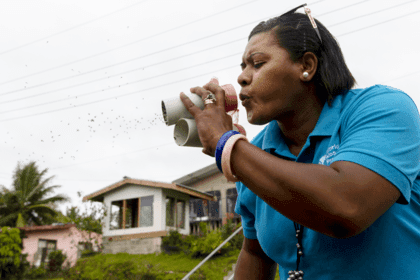
Then one morning, a white minivan began making its way through his quiet streets. The team inside were not spraying insecticide to limit mosquitoes. Instead, they were releasing them, each one carrying a natural bacterium that blocks their ability to transmit dengue.
"Many people thought it was very strange," says Maciel. "How can you release more mosquitoes? But my thought was that it would work. I just didn't imagine it would work in such a short time."
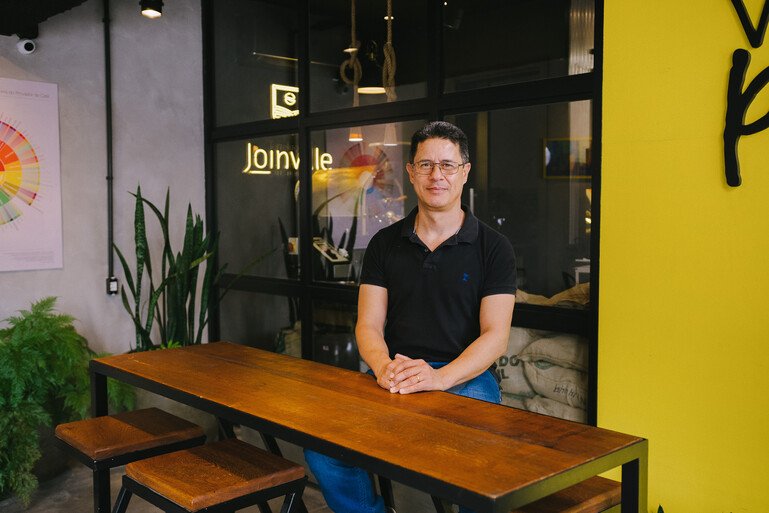
Noel Maciel, a cafe owner who told of the impact of dengue on his community in Joinville, Brazil.
Léo Mello/Camisa Preta Filmes
From the world’s largest mosquito biofactory in Curitiba to the streets of Joinville, this film – produced in collaboration with Devex – follows the scientists, health workers and communities turning a bold idea into real-world protection against dengue.
Pressing play on the video above will set a third-party cookie. Please read our cookie policy for more information.
In Brazil, scientists and communities are teaming up to release mosquitoes that block dengue transmission. This video follows the journey from lab to neighborhood, showing how R&D protects communities from disease.
Noel Maciel: Suddenly, things started to increase, increase, increase. Outbreaks began to appear, and it ended up becoming an epidemic. I have acquaintances who contracted dengue and ended up dying. It was very scary and very fast, right? I believe that in less than five years this thing rose exponentially.
Luciano Moreira: In Brazil especially, we are seeing dengue spreading all over the country and places that never had dengue before. So when we challenged these mosquitoes with dengue, we discovered that Wolbachia was actually blocking the virus inside the cells of Aedes aegypti. So that was a huge discovery. The idea was to produce 100 million eggs per week, so more than 5 billion eggs per year. So it took one year to build this structure, almost 2000 square meters for production sites.
Gabriel Sylvestre: The offspring has Wolbachia, and then generation for generation they are replaced by mosquitoes that cannot transmit. And when the eggs reach the city, the local health agents, they produce mosquitoes and release mosquitoes in the field. So Wolbito do Brasil is now managing and delivering eggs and training people how to do it.
Tamila Klein: We need to explain this to the population. So, our first contact is really about explaining, using simple language and playful methods so that everyone understands, addressing all queries, because I believe that people don't accept what they don't understand. We explain that it's temporary, that we won't be doing it forever. That for a short period there will be more mosquitoes on the streets, but then it stops, and everything returns to normal. The release is done by car. The production process involves placing adult Wolbachia mosquitoes in containers. At each point, the release agents open a container, release the mosquitoes, and let them fly out.
Luciano Moreira: So, in Indonesia, we have around 86% reduction in hospitalizations with the RCT (randomized controlled trials) that happened there. And we also see from cities that they say, yeah, dengue is no longer a problem.
William Garrood: For a technique like Wolbachia, you need to have a greatly increased operational capacity, you need to be able to manufacture so you can produce these mosquitoes at scale. You need to have the logistics in place to actually be able to deploy these in the communities that need them the most, and you need the technical expertise within your workforce to bring this all together. So what you need is long-term secure financing, and then what you would also need is, you need it to be integrated into a health program, controlled methods.
Gabriel Sylvestre: So at Wolbito do Brasil, we have a commitment with the minister of health to cover 7 million people every six months. So for every year we will be covering close to 14 million people. So we have a plan to cover close to half of Brazil in 10 years.
Mathias Gonçalves: It's so important we have the partnership with government and acceptance of government and approval of the government in terms to implement the structure and to organize things.
Noel Maciel: Many people thought it was very strange. "But how can you release more mosquitoes?" I thought that it would work — I just didn't think it would work so quickly. This year, dengue has decreased dramatically. People stopped commenting, stopped saying, "Oh, so-and-so has it, another so-and-so got sick." So, it really became very noticeable.
The Aedes aegypti mosquito transmits dengue, chikungunya, yellow fever and Zika. It breeds in small pools of standing water, bites during the day and is growing resistant to insecticides. Traditional control methods are struggling to keep pace.
For Maciel, the speed of the crisis was terrifying. Outbreaks in Joinville surged in the space of just a few years. “I have acquaintances who contracted dengue and ended up dying. It was very scary and very fast. I believe that in less than five years this thing rose exponentially.”
For those who have had dengue, the memory stays. Adrielly Amarante, a hotel worker from Joinville, contracted the disease four years ago.
It took her almost 60 days to recover. "I wasn't very active, but I used to ride my bike," she says. "Even pedalling slowly or doing daily activities was difficult. I had joint pain, especially behind my knees, and pain behind my eyes.”
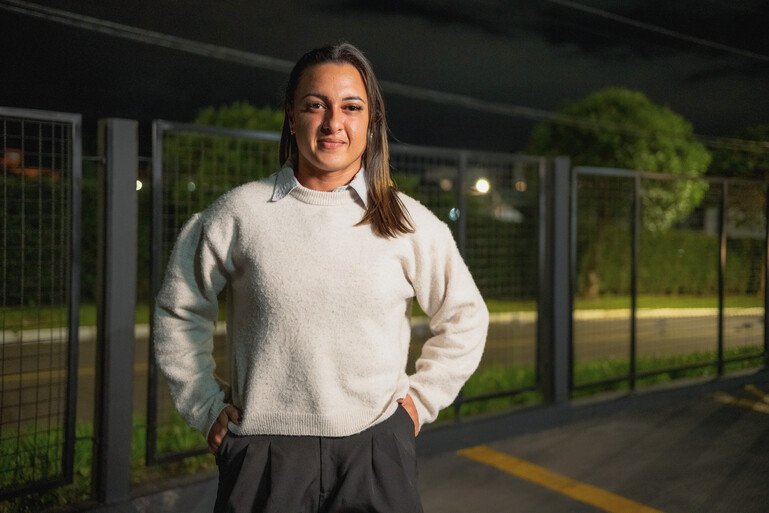
Adrielly Amarante, a hotel receptionist in Joinville, Brazil, who spoke of her experience with dengue fever.
Léo Mello/Camisa Preta Filmes
In 2024, the world experienced its worst year for dengue on record – more than 14 million cases and over 10,000 deaths globally. Brazil bore the heaviest burden, with more than 10 million cases and over 6,300 deaths. Climate change is a driving factor: rising temperatures and shifting rainfall are expanding the mosquito’s range into higher altitudes and latitudes previously too cool for it to survive, while lengthening transmission seasons in regions already affected.
Hear from Professor Scott O’Neill, founder of the World Mosquito Program, who is using mosquitoes infected with a naturally occurring bacterium to revolutionise disease prevention.
Scientists at Monash University in Australia, working through what became the World Mosquito Program, made a pivotal discovery in 2009. They found that that a naturally occurring bacterium called Wolbachia – found in roughly half of all insect species, but not in Aedes aegypti – could block dengue from replicating inside the mosquito. If the virus cannot replicate, the mosquito cannot pass it to a person.
The method is self-sustaining. When an infected female mates, she passes Wolbachia to all her offspring. Once enough of the local mosquito population carries the bacterium, it maintains itself generation after generation. Public-health and regulatory agencies say there is no data suggesting Wolbachia mosquitoes harm people, animals or the environment.
The strongest evidence comes from a randomised controlled trial in Yogyakarta, Indonesia, which showed a 77 percent reduction in dengue incidence and an 86 percent reduction in hospitalisations in areas where the method was deployed. Long-term surveillance in Yogyakarta has since recorded the lowest three-year average of dengue cases in more than 30 years.
Source: Gates Open Res
Monthly notified dengue case incidence (per 100,000 population) in the intervention (solid line) and control (dashed line) areas before and after Wolbachia deployments, January 2012 - September 2019. Blue shading indicates the Wolbachia infection prevalence in Ae. aegypti collected from the intervention area. For more information: https://pmc.ncbi.nlm.nih.gov/articles/PMC7403856/
Outside of clinical trials, the results are being confirmed in country after country. In Niterói, Brazil, the first city to achieve full coverage, dengue cases dropped by roughly 90 percent. In Colombia’s Aburrá Valley, cities including Medellín recorded their lowest incidence in 20 years in 2024, even as the rest of the country faced a national epidemic. Across all sites, the World Mosquito Program’s internal modelling estimates that they have prevented 1.5 million dengue cases and 93,000 hospitalisations, saving an estimated US$455.7 million in healthcare costs.
Source: World Mosquito Program
An interactive world map shows where the World Mosquito Program has deployed Wolbachia mosquitoes and the number of people reached in each country.
Note: Data is not yet available for Timor Leste. Due to a display error, Kiribati is currently not displaying in map view.
Sorted alphabetically by country
Source: World Mosquito Program
An interactive world map shows where the World Mosquito Program has deployed Wolbachia mosquitoes and the number of people reached in each country.
Note: Data is not yet available for Timor Leste. Due to a display error, Kiribati is currently not displaying in map view.

Turning a laboratory discovery into a national health tool takes more than good science. In Curitiba, Brazil, a joint venture between the World Mosquito Program, the Oswaldo Cruz Foundation (Fiocruz) and the Institute of Molecular Biology of Paraná has built one of the world’s largest mosquito-rearing facilities, designed to produce more than five billion Wolbachia mosquito eggs a year.
Léo Mello/Camisa Preta Filmes
It begins here – with a sieve, a steady hand and thousands of mosquito eggs. Every egg produced at the Curitiba biofactory carries Wolbachia, the bacterium that will stop dengue in its tracks.
Léo Mello/Camisa Preta Filmes
"We scaled five to ten times. We moved from 10–15 million eggs per week to more than 100 million. This means we can protect many more people. Brazil is a big reference for scale-up – a model for other countries.”
– Mathias Gonçalves, Executive Director of Manufacturing, World Mosquito Program
Léo Mello/Camisa Preta Filmes
Inside the enclosures, Wolbachia mosquitoes breed and lay eggs, passing the bacterium on to the next generation.
Léo Mello/Camisa Preta Filmes
Before any mosquitoes are released, teams spend months building trust with communities. In a country where public health messaging has long emphasised eradicating mosquitoes, deliberately releasing them demands careful engagement. Acceptance rates across Brazil’s first wave of cities have been consistently high – reaching 99 percent in Londrina and 93 percent in Foz do Iguaçu.
Léo Mello/Camisa Preta Filmes
“I believe that people don’t accept what they don’t understand. Once they understand the method, everyone agrees.”
– Tamila Kleine, Regional Operations Coordinator for Wolbito in Brazil
Once communities are on board, the releases begin.
Léo Mello/Camisa Preta Filmes
Egg capsules from Curitiba are sent to regional teams across Brazil. Local health workers hatch them into adult mosquitoes, ready for release.
Léo Mello/Camisa Preta Filmes
Each container holds the next generation of dengue-free mosquitoes.
Léo Mello/Camisa Preta Filmes
The containers are then loaded into the "mosquito car" for local teams to distribute at set points across the city.
Léo Mello/Camisa Preta Filmes
At each stop, a container is opened and the Wolbachia mosquitoes fly out into the streets of Joinville – a small intervention with the power to change how a city lives with dengue.
Léo Mello/Camisa Preta Filmes
Wellcome has supported the World Mosquito Program since 2016, alongside partners including the United States Agency for International Development, the UK government and the Gates Foundation. That sustained commitment has helped the programme move from localised pilots to an international operation.
"To move a promising idea like Wolbachia from small pilots to a country programme, you need long-term planning and investment," says William Garrood, senior research manager in Wellcome's infectious disease team. "That means manufacturing capacity, robust logistics, technical expertise in the workforce and strong community engagement – alongside secure financing and government partnership so programmes can be sustained."
In 2022, Brazil’s health regulator approved the Wolbachia method – a turning point that moved it from a research programme into national health infrastructure.
"Two years ago, the Ministry of Health decided to adopt Wolbachia as a public health initiative," says Luciano Moreira, CEO of Wolbito do Brasil. "It's now part of their strategy for dengue control."
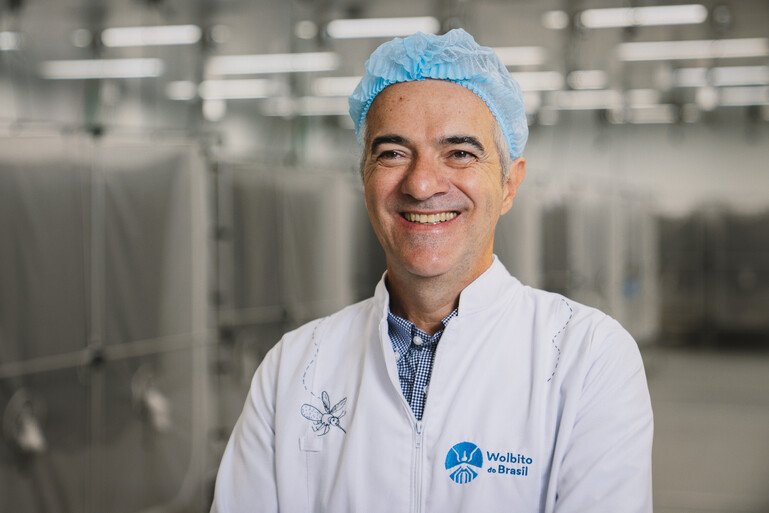
Luciano Moreira, CEO of Wolbito do Brasil, inside the company's biofactory in Curitiba, Brazil.
Léo Mello/Camisa Preta Filmes
Gabriel Sylvestre, Wolbito do Brasil’s implementation manager, says the ambition is to reach more than 40 municipalities by the end of 2026. “We’re really keen to see this going even bigger. In Brazil, we have a commitment with the minister of health to cover seven million people every six months. We have a plan to cover close to half of Brazil in ten years.”
While the release vans move on, back in Joinville, the Wolbachia mosquitos remain. And residents like Noel hope to see them keep doing their work to protect the next generation.
"This year, dengue has fallen dramatically," he says.
"People stopped commenting, stopped saying, ‘Oh, so-and-so has it, another got sick.’ It really became very noticeable.”
In the fight against dengue, communities like Joinville have found an unexpected ally. For the first time, that ally is the mosquito itself.
Tags