The Human Genome Project: finding community in the code of life
The Human Genome Project was one of the most significant scientific endeavours in history. It laid the foundations for countless innovations in health and medicine. And through big commitments to open science, it brought answers, community and a future to families affected by rare genetic diseases.

Licence: Attribution CC BY
13-minute read
13-minute read
Elapsed time:00:00Total time:00:00
“She’s like sunshine,” says Lisa Doherty, describing her 16-year-old daughter, Lulu. “When she walks in a room people are drawn to chat to her.”
“She loves to talk, loves to meet people,” adds Phil, Lulu’s dad. Whether on the train, out and about in her neighbourhood or on a family trip to the local pub, Lulu is always asking questions.
Lulu has a rare genetic condition, called Jansen-de Vries syndrome. It’s a developmental disorder caused by a fault in a specific gene, called PPM1D. Fewer than 100 cases have been reported in medical literature.
A joyful, hyper-sociable nature is often one of a number of overlapping clinical traits – many of which can also be challenging, impacting health and wellbeing.
“Lulu has been quite toddler-y since she was a toddler and still is,” says Lisa. “She needs a lot of looking after and protecting – for all her delightful personality.”
During the first six years of Lulu’s life her family had no word for the cause of their experiences. It was a lonely time.
But that all changed in 2016 when a doctor called Lisa to explain that they’d found the genetic cause of Lulu’s condition. It finally had a name.
This didn’t change Lulu’s treatment options. But it put to rest years of worry that Lisa and Phil, as parents, had caused or passed on her condition. And it opened up a new world of community, support and a vision for their daughter’s future that they never thought possible.
Watch: A six year search for answers and the community that followed
Pressing play on the video above will set a third-party cookie. Please read our cookie policy for more information.
Phil
Lulu is absolutely adorable. She's 16 now. Just a really lovely, very funny kid.
Lisa
She's like sunshine. To have an answer, it really has changed our lives.
Helen Firth
There are several thousand rare genetic developmental disorders. And that makes it so difficult to recognise an individual condition when you see a child in clinic. Getting a genetic diagnosis is often a huge relief to families who've worried about whether it was something that they did and to realise that it was just chance. When I first started working in this clinic 30 years ago, for the majority of families, we ended up without any answers. It was very frustrating. And that's what made me so excited by the Human Genome Project and the opportunities it opened up for us.
Archive news report
Compiled last year by scientists working here at the Sanger Centre in Cambridge and in the United States, the human genome finally goes public.
Tim Hubbard
Oh, we always like to have a good party. It really was a triumphal celebration. We were all part of this massive project.
Archive news report
In a thousand years time, they'll look back and say, that was when the human genome was sequenced. And that was the most important scientific achievement of that era.
Tim Hubbard
The Human Genome Project was to determine the three billion letters that make up the genome. So if you had the human genome and could sequence individuals and see their differences, you'd be in a better position to understand the actual causes of diseases. The Sanger Institute, funded by the Wellcome Trust, was really a key player in the sequencing project. When I joined in 1997, sequencing was so difficult. A single machine would only sequence a few hundred letters at a time. In 1998, it became clear that a commercial company was going to sequence the human genome privately and provide that data as a subscription. And so then there became a real push that we should make sure that there's always going to be a public version of the human genome.
Archive news report
For Sir John Sulston, director of the Sanger Centre, this free release of the data is vital.
John Sulston (archive)
All of this should be in the public domain. It should not be something which is essentially based in profit making.
Tim Hubbard
So Wellcome doubled its commitment to funding that Sanger would sequence a third of the human genome. We had hundreds of machines around the world working 24/7.
Archive news report
A revolution in medical science whose implications far surpass even the discovery of antibiotics.
John Sulston (archive)
The discovery of the code of life is only the beginning. This is certainly laying the foundations of a new biology and of a new medical science.
Tim Hubbard
You know, one of the areas where it really is possible to apply it has been rare diseases.
Lisa
So when Lulu was born, she had lots of gastro problems, and she couldn't feed properly.
Phil
She wasn't reaching her milestones.
Lisa
You just got this feeling something's not right. When you have something that has no name, no one really wants to help you in the medical profession because they don't know. Then all the testing started to find out why, what was causing it, and everything came back negative. Our genetic consultant said, "I've drawn a blank. We're going to put you onto this DDD study."
Helen Firth
Deciphering Developmental Disorders, the DDD study, was a huge UK-wide study which had two aims. First was transforming the process of diagnosis of rare disease in children, and the second was defining the genomic architecture — what genes are causing these rare diseases? The study was a partnership between the clinicians in the NHS and the Sanger Institute, providing the world class genomic analysis. Melding those two together made the project such a success. Now we can look at all of the genes simultaneously. You've got so much greater chance of getting to a diagnosis.
Lisa
Around February 2016, the paediatric geneticist in London, she called us to say they've found the gene that is responsible for Lulu's learning difficulties. PPM1D was the name of the actual gene that mutated. It then got called Jansen-de Vries syndrome. It was amazing. It was the best thing to hear.
Lisa
It was so exciting to have an answer. It brought a bit of peace. Then it also enabled other people to understand — oh, it's genetic. Right. Okay.
Phil
We can now see Lulu's future. Rather than catastrophising, we can see people who are in their 50s who have it. We've met them and sort of plan better for life.
Lisa
So it really has changed us and changed our lives because we've just got this community now of people that get it.
Helen Firth
The DDD study, apart from delivering diagnoses for about 5,500 families, has identified 67 new genes causing rare developmental disorders. Behind every diagnosis, there's a child and a family.
Lisa
Studies like this have to keep happening because without them, loads more parents are going to be just left wondering and have a very different outlook on their child's life.
One letter can change a life
Understanding what it took to identify Lulu’s condition requires a grasp of the scale of the human genome.
Inside each of your cells is DNA, which is formed from just four chemical letters. This essential molecule is strung together in a code 3 billion letters long that serves as a recipe for human life – your genome.
It’s a striking combination of immense scale and total simplicity. However, in some cases, a single change in the code causes problems.
Those errors may be well known and affect millions of people worldwide, such as the genetic changes linked to various forms of cancer. But other disease-causing genetic variations are much rarer, occurring early in development and affecting a small number of children from birth. Many more genetic causes remain unidentified.
Just a single letter change can “completely transform a child’s life,” says Helen Firth, consultant clinical geneticist at Addenbrooke's Hospital in Cambridge. “There are several thousand rare genetic developmental disorders. That makes it so difficult to recognise an individual condition when you see a child in clinic.”
When she first began working in this field 30 years ago, Helen and her colleagues could diagnose only around 10 to 15 percent of children with rare developmental conditions – and the process was painfully slow, testing one gene at a time.
“For the majority of families, we ended up without any answers,” she recalls. “It was very frustrating.”
The Human Genome Project played a huge part in changing this.
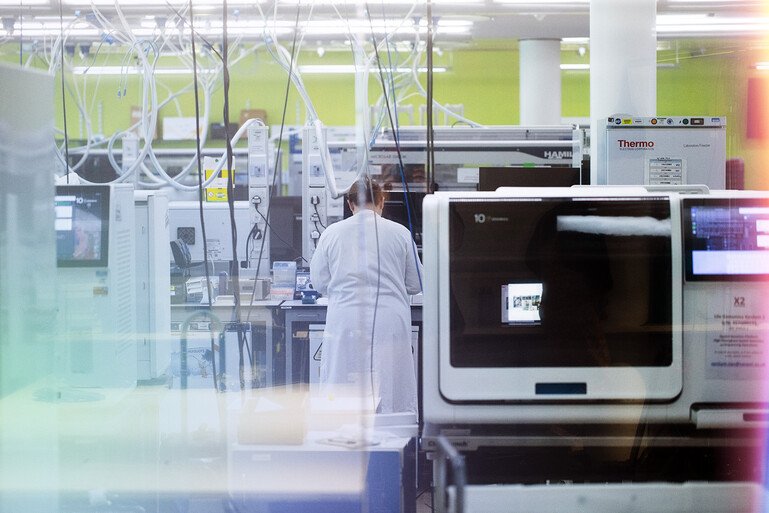
The Human Genome Project helped build the large-scale genomic analysis expertise later used in the study that identified the cause of Lulu’s condition.
The world’s largest collaborative biological research project
In 1990, an international consortium of publicly funded researchers set out to map the entire human genome. Spanning 20 separate universities and research centres across the US, UK, France, Germany, Japan and China, the Human Genome Project set a blueprint for big, collaborative science. All while pushing to sequence the blueprint of human life.
Wellcome was a founding funder. And by 1992, it had established the Wellcome Sanger Institute, near Cambridge, as a focal point for the effort. The institute, now a world leader in genomics research, would go on to sequence a third of the human genome.
But the public consortium wasn’t the only group with the goal of sequencing the human genome.
“In 1998 it became clear that a commercial company was going to sequence the human genome privately and provide that data as a subscription,” recalls Tim Hubbard, former head of human genome analysis at the Wellcome Sanger Institute. “There became a real push that we should make sure there's always going to be a public version of the human genome.”
Wellcome doubled its commitment, backing the public project to ensure the code of life would remain open and ultimately contributing £210 million to the effort. Hundreds of machines ran 24 hours a day, seven days a week.
The draft genome was announced in June 2000, jointly by the public project and Celera, the company behind the private effort. Publication followed in early 2001 and the project was declared complete in 2003. From the outset, the data was freely available – a commitment born from a 1996 meeting of leading genome researchers who agreed to what became known as the Bermuda Principles.
They required researchers to release new sequence data publicly within 24 hours. This open data culture shaped an entire generation of genomic science, including what came next for Helen and her colleagues.
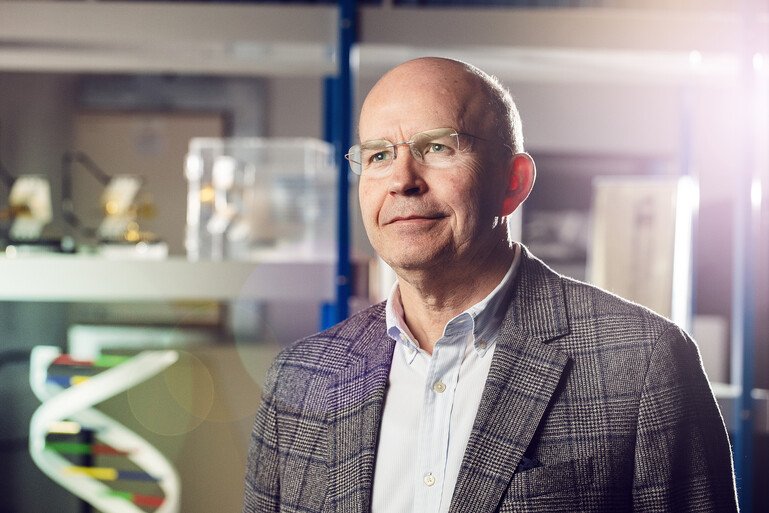
Tim Hubbard, former head of human genome analysis at the Wellcome Sanger Institute, describes the effort to keep the human genome freely available to everyone.
It wouldn’t have been possible without open science
As a new consultant, Helen recalls the excitement of finally having the human genome as a map to guide their work.
“I was excited by the potential it had to really change practice in the clinic,” she says. “I remember watching the news bulletins. I’ve actually kept my copy of Nature from 2001.”
But the map was complex. And Helen was left wondering how clinicians like her would use it.
This ultimately inspired her idea for DECIPHER: a research platform to map clinically relevant variants in the genome, making rare findings discoverable to teams around the world. Wellcome funded it from the start.
“Many of the conditions I work with are extremely rare,” says Helen. “Working my entire career in Cambridge, I might never see another patient with such a rare condition.
“DECIPHER, because it’s used by genetics teams all over the world, enables us to have that global reach – which you need to make progress for families with rare disease.”
From there the team launched the Deciphering Developmental Disorders study in 2011. It was a partnership between the NHS – providing clinical information and patient recruitment across 23 regional genetic centres – and Sanger, which was equipped with industrial-scale genomic analysis experience as a legacy of the Human Genome Project.
Improving technology meant the study could now look at all 20,000 protein-coding human genes simultaneously. This process, known as exome sequencing, provided an increasingly efficient way to identify disease-causing genetic changes.
Having access to this data means “you've got so much greater chance of getting to a diagnosis,” says Helen. As a result, the diagnostic rate for these rare developmental diseases rose from 10 to 15 percent to 28 percent in the first thousand patients – and approaches 40 percent today.
Studies like this are what’s possible when the human genome sequence is open and accessible to all.
“It’s our common heritage – it really belongs to all of us,” says Helen. “If you had to apply for a licence to access this data, you’d be restricting the opportunities for genetic diagnosis.”
Helen is adamant that the projects she has led would not have been possible if the human genome sequence had ended up in private hands.
The Deciphering Developmental Disorders study has made 5,500 diagnoses possible for families and identified more than 60 new genes causing rare developmental disorders. Each of those diagnoses represent conditions that, until recently, were leaving families without answers.
When Lisa, Phil and Lulu provided their DNA samples to the study they were given no guarantees on when, or even if, they might hear anything. Lisa recalls the moment they received an answer.
“I was in the kitchen – and it was amazing. To have an answer that this was something made when she was in the womb. No external factors. It is rare. It felt like it changed everything – and for the time being it changed nothing. It didn’t change day to day, but it brought peace, which was amazing.”
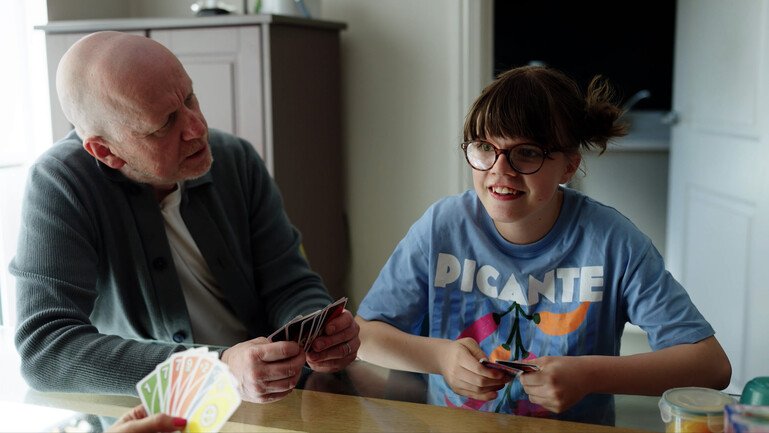
Lulu’s diagnosis gave her parents, Lisa and Phil, answers after years of uncertainty and connected the family with others who shared their experiences.
What was the impact of the Human Genome Project?
Completing the Human Genome Project in 2003 marked the beginning of a new genomic era.
It had profound and wide-ranging impacts on science, medicine and society:
Precision medicine
The Human Genome Project enabled the development of personalised medicine, where treatments can be tailored to an individual’s genetic makeup. This has increased the effectiveness of therapies and reduced the occurrence of adverse reactions.
Disease identification and treatment
By identifying genes associated with diseases, researchers have been able to create targeted therapies and improve diagnostic tools for conditions such as cancer, cystic fibrosis and Alzheimer's disease.
Accelerated research
The completion of the Human Genome Project has accelerated research in genetics, leading to the discovery of new genes and pathways involved in health and disease.
Biotechnological innovations
The understanding of genomes ushered in innovations in biotechnology, including the development of CRISPR-Cas9 gene-editing technology.
Economic growth
The investment in genomic research has significantly contributed to economic growth through the creation of new industries in the biotech sector and numerous jobs in research and development.
International collaboration
The Human Genome Project set a precedent for international collaboration in scientific research, with participants from various countries working together towards a common goal.
Open access to data
The commitment to freely sharing Human Genome Project data paved the way for open science initiatives, encouraging global research and collective problem-solving.
Ethical guidelines
The project spurred debates and the development of guidelines regarding the ethical handling of genetic information, privacy and consent.
Public awareness and education
The Human Genome Project increased public awareness and understanding of genetics, prompting discussions on genetic discrimination and the societal impacts of genetic research.
Understanding genetic diversity
Insights from the Human Genome Project have helped researchers understand genetic diversity across populations, which is crucial for addressing health disparities and developing global health strategies.
The cost of sequencing a full human genome has fallen significantly
Chart visible
Source: National Human Genome Research Institute via Our World in Data
One major impact of the project is the acceleration of accessibility and affordability of genomics sequencing.
The cost of sequencing a full human genome dropped from $95 million US$ in 2001, to $342,500 in 2008 and just $525 in 2022.
What is the future of genomics?
The foundations laid by the Human Genome Project continue to inspire groundbreaking research and innovations. Today, Wellcome supports a broad range of projects that use genomic insights to tackle pressing health issues, from infectious diseases to mental health.
And there’s a lot left to discover.
“In many ways, sequencing the human genome was the start of a very long process of interpretation,” says Tim Hubbard, now based at King’s College London. “How much data do we need to improve interpretation – that’s a current question.”
Representation in genomic studies plays a big part in this.
The Human Genome Project and the projects that stemmed from it overwhelmingly focussed on sequencing the genomes of people of European descent, and there are disparities in genomics capacity globally. This must be addressed so we can all benefit.
With more and better data, frontier technologies like Artificial Intelligence (AI) will also likely play an increasing role in genomics, much like it did in Nobel Prize-winning work to predict the structure of proteins.
Protecting privacy, ensuring diversity in data and transparency must therefore all remain priorities.
Huge effort has been put into reading genomes. The future may look to write them. Projects like the Synthetic Human Genome project are developing the technology to make this possible, starting with the goal of creating the first synthetic human chromosome. Again, focus is being given to the social and ethical discussions that must happen alongside discovery research like this.
Because, ultimately, the code of life is ours. “Behind every diagnosis, there's a child and a family,” says Helen.
The future of genomics must therefore consider the future of the people it affects.
“A huge thing is we can now see Lulu’s future, rather than catastrophising,” says Phil. “We can see what to expect and plan better.”
“Studies like this have to keep happening,” adds Lisa. “Because without them, loads more parents are going to be just left wondering.”
Tags

