The Ebola vaccine story: what it achieved and where the gaps remain
Wellcome played a crucial role in responding to the 2014-16 West African Ebola epidemic. We’ve since invested over £41 million with partners to support the global response to Ebola. Today, there are two licensed vaccines for Zaire ebolavirus.

Ebola vaccine
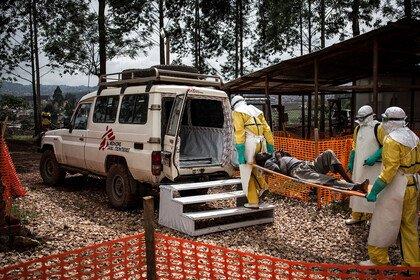
Credit:
Licence: All Rights ReservedAlexis Huguet / AFP
Elapsed time:00:00Total time:00:00
In 2014, an epidemic of Ebola virus disease spread across West Africa. Caused by Zaire ebolavirus, this became the biggest and deadliest outbreak of the virus since it was first identified in 1976. Ebola spreads quickly and has an average case fatality rate of around 61%, making it a severe threat.
Tackling the 2014-16 West African Ebola epidemic
Between 2014 and 2016, there were over 28,000 suspected cases and 11,000 deaths across West Africa. At that time, no vaccines or treatments were available.
Overcoming this outbreak required a multifaceted approach. Vaccine development, public health initiatives and community engagement were all vital.
The UK Government led initiatives in Sierra Leone – where they constructed treatment centres, increased treatment beds and supported burial teams.
Efforts went beyond medical interventions. They included training health workers in community engagement and improving diagnostic tests. Predictive mapping was also used to understand and control disease spread.
Wellcome's commitment to vaccine development
Wellcome, alongside other global partners, supported the development of a vaccine for the Zaire ebolavirus strain. The ERVEBO® vaccine was developed and tested during the epidemic and was critically important in bringing the outbreak to a close. It was subsequently approved in 2019.
Previous progress around vaccine development had been slow, and the outbreak presented an urgent need for a rapid scientific response. Wellcome provided essential resources, enabling trials of safe and effective vaccines to reach the delivery phase. Beyond direct funding, we also facilitated international cooperation. The resulting knowledge exchange and collaboration between partners were crucial to reaching a solution.
The introduction of ERVEBO® was transformative in helping to control the spread of the Zaire ebolavirus species. The vaccine's efficacy exceeded 95% in trials, and had an overall effectiveness of 84%.
This scientific milestone helped to provide a framework for how a vaccine could be used as part of a response to future outbreaks caused by Zaire ebolavirus.
Who has benefitted from the ERVEBO® vaccine
In the context of the 2014-16 West African epidemic, the vaccine helped protect the communities most at-risk, particularly in Guinea, Sierra Leone, and Liberia where the outbreaks were widespread.
The “double ring vaccination” strategy helped to contain outbreaks by vaccinating all close contacts of a case, as well as their contacts, to prevent transmission. The vaccine was also given preventatively to healthcare workers, working as an extra layer of protection.
The response to the West African Ebola outbreak highlighted the need for better epidemic preparedness. This led national bodies and global health groups to enhance response strategies by learning from the experience. The WHO created an R&D blueprint, and the Coalition for Epidemic Preparedness Innovation (CEPI) was formed to boost global vaccine development and collaboration.
CEPI is a global partnership based on collective action which works to accelerate the development of vaccines to contain outbreaks before they become emergencies. It's supported by over 30 national governments, the European Commission and key philanthropic organisations, including Wellcome.
Investing in research, as well as the essential infrastructure to support it is crucial to be able to respond with interventions in a timely way during outbreaks.
Preparing for future outbreaks: what challenges remain?
The story of the ERVEBO® vaccine highlights the power of science and collaboration, however many challenges remain.
Critically, both of the vaccines currently approved are only effective against the Zaire species.
Other Ebola species also cause outbreaks in humans, including the 2026 outbreak, which is caused by the Bundibugyo species. In these instances where there are no approved vaccines or treatments, outbreaks are more difficult to contain and rely solely on public health measures such risk communication around reducing transmission, surveillance to monitor the spread of the virus, and providing care for those impacted.
Other vaccine candidates that target non-Zaire species are in development but require sustained global funding and country approved strategies to assess novel vaccines during outbreaks. Otherwise, any approved vaccines could remain inaccessible to the communities most affected.
Vaccines are also only one aspect of preparation for future outbreaks. There are persistent gaps in the preparedness and response ecosystem, including in treatments, diagnostics, and disease surveillance.
Closing these gaps requires coordinated action to protect those most at risk.
Timeline of impact
2014
Ebola outbreak intensifies across West Africa, sparking a global response to find a vaccine.
2015
The WHO leads a ring vaccination trial in Guinea with the support of Wellcome, showing promising results.
2016
ERVEBO® vaccine proves to be effective and leads to regulatory approval discussions.
2019
The WHO prequalifies the Ebola vaccine ERVEBO®, marking it ready for use in outbreak regions.
2020
The vaccine is deployed in outbreak regions. This significantly reduced new cases and prevented future spread.
2021
Ongoing surveillance and vaccination efforts continue. Feedback was used to prepare swift responses to potential health crises.
2022
Initiatives for vaccine distribution expand, reaching more remote areas.
2023 onwards
Wellcome and its partners focus on further research and development. Efforts continue to improve vaccine accessibility. This is part of a broader global health preparedness strategy.
For enquiries relating to the current Ebola outbreak, please email: epidemics@wellcome.org
Tags