
Transforming how people manage paranoia
Lived experience is the heart and soul of SloMo, a therapist-delivered, digitally supported therapy for paranoia. Created in a unique collaboration of clinicians, designers and people with lived experience of paranoia, it is improving treatment options while demonstrating the real-world impact of mental health research.

Licence: Attribution CC BY
11-minute read
11-minute read
Elapsed time:00:00Total time:00:00
“The number one thing SloMo has done for me is build confidence,” says Amy Grant. “I hope it will reach the people who usually slip through the net and give them the confidence to achieve what they want in life.”
Amy Grant is a lived experience researcher on SloMo, a digitally supported therapy for people experiencing paranoia in psychosis. She is one of the people whose own understanding of paranoia has helped shape how the therapy works and how it feels to use – especially for those who might otherwise struggle to access support.
For her, paranoia is not an abstract concept. It can mean worries that appear suddenly and powerfully in ordinary places – on a crowded bus, in a supermarket queue, or in response to a glance from a stranger. “Some paranoid thoughts are common, and most people will experience them at some point, like ‘everyone is watching me’,” she says. “At times the worries can feel embarrassing, but in the moment, the evidence is too compelling to ignore.”
Experience such as this has been central to SloMo’s development. Amy Hardy, Chief Investigator for the project at King’s College London, says lived experience is “embedded throughout SloMo,” describing it as the project’s “heart and soul.”

Amy Hardy, SloMo’s chief investigator at King’s College London, says lived experience is at the heart of the project.
Design has the power to connect diverse insights and create a space for collaboration. Inclusive design helps us ask the right questions, uncover opportunities and develop solutions that create positive impact.
What is paranoia in psychosis?
Paranoia is often understood as a fear that other people intend to cause harm. Amy Hardy says it is common – “one in five of us will experience it often” – but for people with psychosis it can become severe and debilitating. “It can mean that people aren’t able to leave the house, they’re isolated, they’re not able to do the things that they want to do in life,” she says.
Cognitive behavioural therapy (CBT) for psychosis can help and is recommended by the National Institute for Health and Care Excellence (NICE), but access remains limited. It is estimated that only one in ten eligible people may receive such therapy, partly because of the cost involved in training and employing therapists to deliver it.
Research also suggests that people from some racialised and marginalised groups are less likely to receive a full course of CBT and may derive less clinical benefit from it. These challenges highlight the need for approaches that are not only effective, but also more accessible and easier to integrate into everyday life.
SloMo was developed to help address that gap. It combines therapy sessions with a supporting mobile app, giving people practical tools they can use between sessions – and after therapy ends – to manage worries in daily life.
Watch: How SloMo was built around people’s lived experience
Pressing play on the video above will set a third-party cookie. Please read our cookie policy for more information.
“I just want it to help other people as much as it has me.” – Lived experience experts and researchers talk about developing the SloMo app.
Amy Grant
Experiencing paranoia is like a beehive. Busy, noisy, unwanted thoughts racing around. Some paranoid thoughts are common and most people will experience them at some point. Like, "everyone is watching me". But sometimes they can become overwhelming. Constantly buzzing around in your head. At times the worries can feel silly, childish or embarrassing, but in the moment the evidence is too compelling to ignore. This was my experience. I'm Amy, resident zine maker and lived experience researcher. I'm part of a team who are trying to help people overcome these types of worries with a new therapy called SloMo.
Amy Hardy
I've always been very passionate about working in mental health. I think the mind is fascinating and particularly in terms of psychosis. People with psychosis were more likely to have experienced trauma and are more likely to drop out of therapy. The challenge was how do we create a therapy that is more appealing and easier to use that would improve access, experience and outcomes.
Chris
My contribution to this project stems from me suffering with paranoia, anxiety and feeling overwhelmed. Whether it's on the bus or in the queue in the supermarket, or just in a local park.
Amy Hardy
Paranoia is one of the most common difficulties in psychosis. Our ability to go on our gut instincts to make snap decisions. And that's really important because we need to be able to do that to function in life. But if we rely on that too much, it can cause problems. What we set out to do was to try and develop a digitally supported therapy, synchronised with a mobile app for paranoia in psychosis. To support people to learn to slow down their thinking.
Chris
The challenge was for all of us to agree that the app is going to be designed in a way that's going to be suitable for everyone.
Amy Hardy
Wellcome have supported this work. And what they allowed us to do was to put together an interdisciplinary team.
Anna Wojdecka
The key challenge of the project was finding the right analogy that will allow us to visualise thoughts. People who experienced such an emotional distress were finding it very difficult to think with abstract concepts, such as thoughts, while they were experiencing distress.
Chris
We didn't want it to look too dull, but we didn't want it to look too flashy either. If the app was a bit too tricky or flashy to use, that could heighten the anxiety.
Anna Wojdecka
To our surprise, it turned out that the analogy of thoughts as bubbles really resonated with people.
Amy Grant
Just like how speech bubbles let you see what a comic character might be thinking. SloMo uses bubbles to help you write out and see your own thoughts. It gives you a new perspective. You start to ask yourself different questions like, "why did I think that?"
Chris
The bubble's perfect and it can spin as well. If your thoughts are really running, you can slow down the bubble.
Amy Grant
When I did SloMo therapy, writing in the bubbles helped me to slow down and process the situations I'm in. Because I was thinking more consciously.
Amy Hardy
We found that SloMo reduced paranoia, but importantly, we also found that it improved people's confidence, wellbeing, and quality of life. Encouragingly, we found that SloMo was equally effective regardless of people's backgrounds.
Anna Wojdecka
They felt heard. They started going out of the home, something that was really out of reach for them before. Yeah, it was very powerful to hear that.
Amy Grant
The number one thing SloMo has done for me is build confidence. From that, other areas in my life have improved, such as my relationships, socialising, and pursuing other goals. I hope SloMo will reach the people who usually slip through the net and give them the confidence to achieve what they want in life.
Amy Hardy
Digital health has significant potential to revolutionise mental health care. So we're really encouraged and we're very keen to move into scaling up SloMo across other NHS trusts in the UK.
Chris
I'm definitely proud, 100%. I personally do see the difference it can and will make.
Targeting fast thinking
The idea behind SloMo begins with a key psychological insight: the difference between thinking fast and thinking slowly.
Fast thinking is intuitive and automatic. It helps people make quick judgements, recognise patterns and respond to the world without analysing every detail. Slow thinking is more deliberate. It creates space to pause, weigh up evidence and consider other explanations.
Both are useful, but when someone is experiencing paranoia, fast thinking can make threatening interpretations feel immediate and certain. “We know that people experiencing paranoia are more likely to rely on fast thinking,” says Amy Hardy. SloMo is designed to specifically target this process. Its goal is to help people slow down fast thinking, notice new information and consider alternative explanations for what is happening around them.
Importantly, SloMo is not about telling people that their thoughts are wrong. As Amy Hardy explains: “It might be about coming up with an alternative way of thinking about things, but it might also be about what they can do to feel safer or be more able to get on with life.”
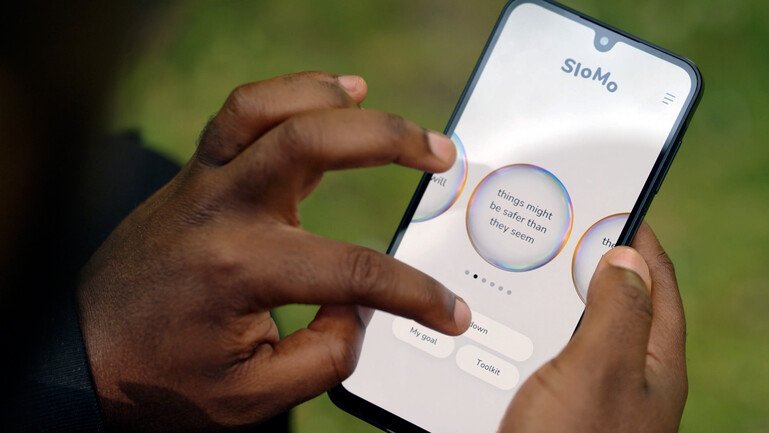
In SloMo, bubbles appear that people can interact with, giving them a visual way to work through their thoughts.
Co-design: making the cake together
“SloMo is a unique example of inclusive design, which included shadowing therapy sessions, design workshops with clinicians, game developers, and designers, and continually testing and refining emerging ideas involving experts with lived experience of paranoia at every stage of the process,” says Anna Wojdecka, who led the design research with the design team at the Helen Hamlyn Centre for Design, Healthcare Lab
“Co-design is about moving beyond involving people with lived experience at the end of a project, almost like putting the icing on the cake” says Amy Hardy. “It’s about actually making the cake together.”
Lived experience experts on the research team, including Amy Grant and Chris, helped shape everything from the language used in the therapy to the way key ideas were presented. At the same time, inclusive design methods from the Helen Hamlyn Centre for Design at the Royal College of Art helped make the therapy accessible, intuitive and flexible. “The challenge was to make it suitable for everyone,” explains Chris.
SloMo’s team wanted to do more than just replicate conventional therapy in digital form. “We had two key problems we were trying to tackle,” says Amy Hardy. “First, how could we better target the processes that play a role in paranoia? And secondly, how could we design a therapy that was more appealing, easier to use and more memorable?”
Addressing those questions required a different way of working. Wellcome funding enabled an interdisciplinary team of clinical researchers, therapists, designers, developers, and people with lived experience of paranoia to create a solution that was both usable and effective.
“Our role was to understand the experience of therapy from different perspectives, and use those insights to identify opportunities for design,” says Anna. The design research included shadowing therapy sessions, participant interviews and design workshops with therapists, people with lived experience, game developers and technologists. Ideas were continually tested, discussed and refined, with feedback from people with lived experience informing each iteration.
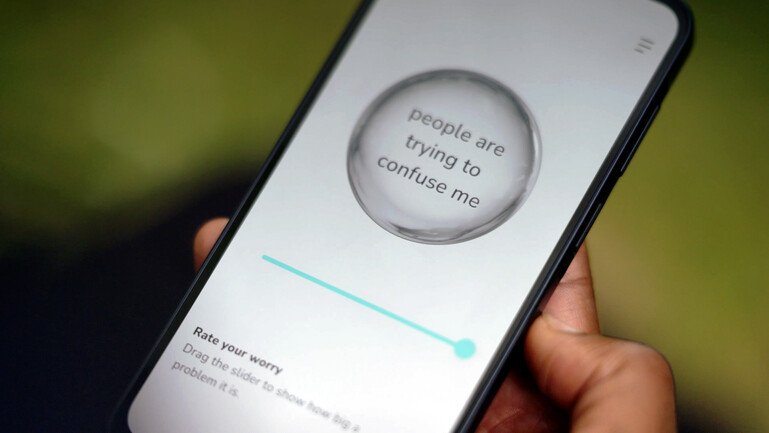
The app lets people put a worry into words and rate how strongly they believe it. The bubble gives that thought a visible form to work with.
Thought bubbles
That collaborative, inclusive approach led to one of SloMo’s defining features: worries represented as bubbles. In the mobile app, users can type worries into animated bubbles, whose size, speed and appearance reflect how intense or convincing a thought can feel.
“The analogy of visualising the invisible – thoughts – as bubbles strongly resonated with people,” says Anna. “By providing the analogy of thoughts as something that can come and go, reflect the environment, come in different sizes, move slowly or quickly, and that you can even pop, we were able to make thoughts more tangible.”
Amy Grant agrees: “Just like how speech bubbles let you see what a comic character might be thinking, SloMo uses bubbles to help you write out and see your own thoughts."
The bubbles therefore became more than a visual feature of the app. They offered a shared visual language for talking about thoughts and thinking patterns – this could not have been achieved without the collaborative design process.
“The power of involving service users with lived experience can really make or break the project, because there is no point designing something that nobody will use,” says Anna. “The app is always there,” says Chris. “It’s almost like a friend.”

Anna Wojdecka led design research and development at the Royal College of Art. She says representing thoughts as bubbles resonated with people involved in designing SloMo.
Does SloMo work?
Results from a large randomised clinical trial were promising. Over six months, people receiving SloMo showed improvements not only in paranoia, but also in confidence, wellbeing and quality of life.
The trial also suggested that SloMo helped bridge the digital divide: although digital access and confidence varied by age and ethnicity, these differences did not appear to affect people’s adherence to the app or their experience of using it.
The next step is understanding how SloMo works in everyday NHS care. “SloMo is currently being rolled out in three NHS trusts to see if and how it can be implemented in routine care,” says Hardy. “That’s going very well so far, so we’re really encouraged.” If findings remain positive, SloMo could be recommended for wider use across NHS services.
Beyond SloMo: digital tools in mental health
SloMo is part of a growing effort – that Wellcome is supporting – to use digital technologies to make mental health support more engaging, accessible and effective. Another example is AVATAR, a digital therapy developed by researchers at King’s College London, which combines talking therapy with digitally created avatars to support people with psychosis who hear distressing voices.
Wellcome’s support for digital mental health extends beyond psychosis, including projects exploring smartphone-based markers for depression in young people, youth depression and anxiety support in Indonesia, and safe, effective regulation of AI tools for mental health internationally.
Across these projects, the challenge is not just whether technology can extend the reach of mental health care, but whether it can do so in ways that people trust, understand and want to use.
That question is especially important for people who face barriers to care – including those from marginalised groups, young people who may not seek help through traditional routes, and communities in places where mental health professionals are scarce, stigma remains high, or services are not well integrated into primary healthcare.
“Digital interventions have huge potential to transform mental health care – but only if they’re grounded in real lived experience,” says Tayla McCloud, Senior Research Manager for Mental Health Innovation at Wellcome. “SloMo shows how the expertise of people with lived experience can drive the design of more useful and efficacious treatments for people with psychosis.”
SloMo was developed by an interdisciplinary team at King’s College London in partnership with The Helen Hamlyn Centre for Design’s Healthcare Lab at the Royal College of Art, then optimised for implementation by Special Projects and Bitjam. Funding for development and scaling of SloMo has been provided by Wellcome, King’s College London, Maudsley Charity, and the National Institute for Health and Care Research.
Tags

