
Why Genomics needs context: A new model of discovery research
The future of genomics will not be shaped by advances in any one field alone. It will be shaped by our ability to understand genomics within the social, cultural, environmental, political and economic contexts in which it exists.

7-minute read
7-minute read
Elapsed time:00:00Total time:00:00
For decades, the field of genomics has delivered remarkable insights into health and disease. Yet many of the questions that remain unanswered sit beyond the boundaries of any single perspective. Questions like, how is heredity understood in different social and cultural contexts? How do conflict, displacement or environmental changes influence the generation and use of new genomic knowledge? How can communities set research agendas and control the collection, storage, interpretation and use of genomic data? And, what new questions become possible when we bring different perspectives together from the start?
Answering such questions requires a different model of research; one built on transdisciplinary collaboration.
The Genomics in Context Awards were created to explore this possibility. Through these awards, genomics, humanities and social sciences and wider stakeholder perspectives are all positioned as central to discovery. The goal of the awards is simple but ambitious: bringing together different forms of expertise can expand what genomics is able to discover, revealing new questions, concepts and approaches that would not emerge within any one field or perspective alone.
Discovery happens when different perspectives meet
Research breakthroughs often emerge when different ideas, methods and perspectives come together. Yet research funding, institutions and career pathways have traditionally been organised around disciplines, creating barriers to collaboration across fields and stakeholders that are further reinforced by power dynamics between institutions, disciplines and social groups.
The Genomics in Context Awards seek to challenge this model. Supporting teams that span genomics, humanities, social sciences and wider societal stakeholders, the programme creates the conditions for genuinely collaborative discovery.
Researchers and stakeholders are encouraged to work together from the earliest stages of project design, ensuring that questions, methods and interpretations are shaped collectively rather than added retrospectively. A central goal is to generate new research questions, methods and approaches by incorporating a broader range of perspectives at the start of the research process.
Importantly, this approach is not primarily about making genomics more ethical or inclusive, although those outcomes matter. It is about creating opportunities for more innovative research. By bringing together diverse forms of expertise, research teams can identify gaps, challenge assumptions and generate knowledge that would otherwise remain invisible.
A global portfolio of discovery
The resulting awards portfolio spans 12 projects and represents a £5.75 million investment from Wellcome in transdisciplinary discovery research.
These projects will explore what is possible when genomics is studied within its social, cultural, environmental, political and economic contexts. Working across Africa, Latin America, the Caribbean and conflict-affected regions, they address antimicrobial resistance, infectious disease transmission, pregnancy loss, urban pathogen exposure and environmental damage caused by war. Others explore how race, ancestry, heredity, disability and Indigenous Knowledge shape genomic research. The projects bring genomics into collaboration with anthropology, history, ecology, archaeology, law, architecture and community knowledge.
By combining these different forms of expertise from the outset, researchers and stakeholders aim to reveal patterns, questions and concepts that genomic data alone may not uncover. This research will generate new evidence, methods and frameworks for studying disease, populations and environments, while extending genomic discovery into settings and communities historically underrepresented in research.
Collectively, the projects show how context can open new directions for genomics.
Explore the research
- UBUNTU-GENE: Co-creating Discovery Research on Heredity, Disability and Care in Africa
Segun Fatumo
Ubuntu-GENE explores how African perspectives on heredity, kinship, personhood and care intersect with genomics and disability research in Uganda and Rwanda. The project will develop new research frameworks and governance approaches rooted in Ubuntu philosophy and shaped by people with lived experience of disability.
- Genomics Across Borders: Co-Developing Equitable and Community-Centred Frameworks for Pathogen Genomic Surveillance in East Africa
Jesse Gitaka
Focusing on malaria along the Kenya-Uganda border, this project investigates how community knowledge, anthropology, bioethics and health systems research can reshape pathogen surveillance. It aims to establish a more equitable and socially grounded model of genomic governance and cross-border surveillance.
- Beyond Inclusion: Enabling Equitable Genomic Discovery in Caribbean Populations Across the UK and the Caribbean
Veline L'Esperance
This project addresses the underrepresentation of Caribbean populations in genomic research by examining how ancestry categories are defined and applied. Through genomics, governance research and community engagement, it aims to create more inclusive approaches to genomic discovery.
- A Multi-Omics Profiling of Infectious Drivers of Miscarriage and Stillbirth in a High-Burden Ugandan Population (OPIDMIS-Uganda)
Adrian Muwonge
Combining genomics, metagenomics, epidemiology and social science, this project investigates infectious causes of miscarriage and stillbirth in eastern Uganda. Alongside generating new genomic evidence, it seeks to better understand the social dimensions of pregnancy loss and improve support for affected communities.
- Genomics in Context: Scientific Sovereignty and Community Engagement in Central Argentinean Paleogenomics
Rodrigo Nores
Working with Indigenous communities in Córdoba, this project brings together paleogenomics, archaeology and oral histories to study ancient population dynamics and pathogen evolution. A central aim is to strengthen scientific sovereignty through local infrastructure, community participation and shared governance of genomic research.
- From Molecules to Mandates: Soil eDNA as a New Frontier in Detecting Wartime Environmental Harm and Informing Legal Frameworks
Naomi Laura Jane Rintoul-Hynes
This project investigates how warfare affects soil ecosystems by combining metagenomics, environmental science, machine learning and legal analysis. It seeks to develop new tools for monitoring environmental harm, supporting ecological recovery and informing accountability frameworks in conflict zones.
- Connecting Indigenous Knowledge and Environmental Genomics for Water-Based Antimicrobial Resistance Surveillance in the Peruvian Eastern Amazon
Paola Alejandra Torres-Slimming
Working with Shipibo-Konibo communities, this project integrates Indigenous ecological knowledge with environmental genomics to strengthen antimicrobial resistance surveillance in Amazonian water systems. It aims to create culturally grounded and locally trusted approaches to environmental health monitoring.
- Pathogen Urbanism: Genomics, Social Interactions, and High-rise Urban Forms in Global South Cities
Mathews Jackson Wakhungu
This project investigates how rapid urbanisation and high-rise settlements influence pathogen exposure and transmission in Nairobi. Bringing together genomics, architecture, urban planning, social science and citizen science, it seeks to develop a new framework for understanding pathogen ecologies in rapidly growing cities.
- Plague Genomics in their Social and Ecological Contexts in the Brazilian Hinterland (1920-Present)
Team led by Matheus Filgueira Bezerra, Fiocruz
Using archives, oral histories, and genomic data extracted from Yersinia pestis DNA obtained from both acient-taxidermised and present-day rodents, this multidisciplinary and international project will investigate the ecological and evolutionary consequences of plague, a disease caused by the bacterium Yersinia pestis, spilling over and spilling back between humans, rats, and wild rodents in the Brazilian sertão from 1920 to the present.
- BRIDGE: Bidirectional Research in Genomic Epidemiology – Integrating Community Knowledge with Pneumococcal Genomic Surveillance in Malawi
Jennifer Elizabeth Cornick
BRIDGE examines whether community knowledge can help explain patterns of pneumococcal transmission that remain unclear through genomic surveillance alone. By combining genomics, ethnography, machine learning and community co-design, it explores how social knowledge can enhance disease surveillance.
- Cartographies of Difference: Unsettling Race in the South African 110K Genome Project
Jantina De Vries
This project investigates how population categories can be defined and used responsibly within genomic research in South Africa. Through historical research, genomics dialogue and community engagement, it aims to develop approaches that balance scientific validity with genomic justice.
- Translating Microbial Genomics to Action in Conflict Settings
Leena Layth Al-Hassan
This project explores how conflict, displacement and political instability shape the generation, interpretation and governance of microbial genomic data in Iraq, Syria and Sudan. By integrating genomics, ethnography and political analysis, it aims to develop more equitable and effective approaches to antimicrobial resistance surveillance in fragile settings.
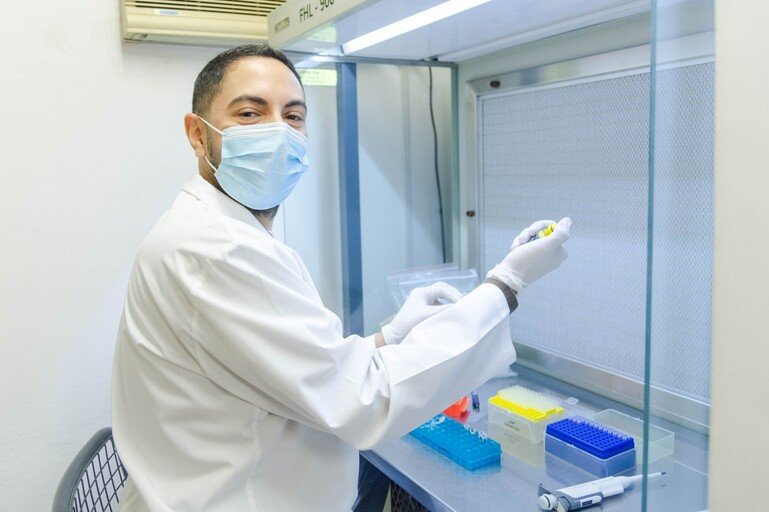
Dr Darío Ramirez at the Instituto de Antropología de Córdoba (CONICET/UNC), Argentina works in a genomics laboratory. He is part of the team researching Scientific Sovereignty and Community Engagement in Central Argentinean Paleogenomics.
Item 1 of 2
What does this mean for the future of genomics?
The significance of Genomics in Context extends beyond the projects themselves.
Ultimately, the programme is testing a new model of discovery research, one that recognises the value of bringing different forms of knowledge into conversation from the start. To create these awards, we first focused on understanding the field and testing the idea. This began with a workshop and report that convened a diverse group of researchers and stakeholders, followed by a comment piece from our team in Nature Reviews Genetics that set out the rationale and ambition for this approach.
It is an approach that centres communities, practitioners and people with lived experience as knowledge holders and knowledge creators, rather than participants alone. And it values disciplinary differences as sources of innovation rather than barriers to be overcome. It's a model that we want to test and are therefore also funding PHG Cambridge to help us evaluate the Genomics in Context programme and develop a better understanding of the value of this kind of transdisciplinary collaboration through it.
As genomics moves into increasingly complex areas, from precision medicine to environmental monitoring, innovations will depend less on any single approach and more on how different perspectives can drive discovery together.
The promise of putting genomics in context is not just more inclusive research. It is more expansive research. By broadening who contributes, what questions are asked and what knowledge is valued, we may unlock new frontiers of discovery and, in doing so, help shape the next chapter of genomics.

