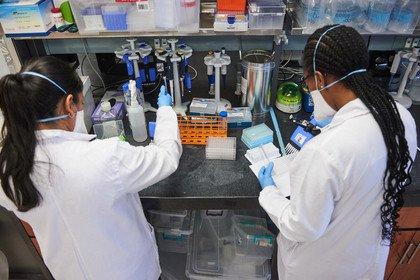
Clinical research careers: £155mn funding for doctoral training programmes
Wellcome is investing in the next generation of healthcare professional researchers with 14 new doctoral training programmes across the UK.
5-minute read
5-minute read

Research-active healthcare professionals don’t just look after the health of the nation; they also make essential, unique contributions to medical innovation to improve our health in the long run. Their research harnesses their extensive knowledge of clinical realities and their experience working with patients to bring about new discoveries about human health.
We have heard how challenging these careers can be: finding research training opportunities, completing a doctorate, and then remaining academically active, all while balancing a demanding NHS career is very difficult. As a result, the number of healthcare professional researchers in the UK has dwindled in the last decade.
At Wellcome, we want to contribute to reversing that trend. That’s why we’re investing £155 million into 14 new doctoral programmes for healthcare professionals across the UK.
Healthcare Professional researchers are essential for the research sector. Working on the frontlines of healthcare – from doctors and nurses, to physios and pharmacists – they gather a wealth of crucial insights that sustains excellent discovery research. However, we know that getting onto and progressing through the dual career pathway with the need to balance research alongside intensive clinical practice is often incredibly challenging.
The 14 doctoral programmes we are supporting address those barriers, particularly through the innovative use of the funding to support career transitions and progression. As well as building positive research and training environments, as a cohort of programmes they bring together a diverse mix of specialists, encouraging collaboration on a whole new scale. These programmes won’t just provide essential research qualifications, but a platform to conduct world-class research and make discoveries that transform our health for generations to come.

Ben Murton
Head of Early Career and Career Development Researchers
Wellcome
Our funding enables institutions to run doctoral programmes that will recruit a diverse range of healthcare professionals, including:
- nurses
- midwives
- pharmacists
- vets
- dentists
- doctors
- allied health professionals
The doctoral training they will provide is a key entry point to an academic research career. The programmes are also set up to actively address concerns about the retention of their fellows in research. We’ve empowered them to think about the specific barriers their fellows will face when trying to continue research alongside clinical practice once their doctorate is complete, and part of the funding is earmarked for them to directly address the concerns they have identified.
- Africa-Asia Health Research Training Programme (CREATE) – led by Rashida Ferrand at the London School of Hygiene & Tropical Medicine, in partnership with University of Bristol, University of Sheffield, University of Southampton and University of Sussex.
- Doctoral Programme in Cancer Research for Healthcare Professionals – led by Clare Turnbull at the Institute of Cancer Research, in partnership with the Royal Marsden NHS Trust.
- Enabling better use of digital tools and artificial intelligence approaches for better health – led by Sinéad Langan at the London School of Hygiene & Tropical Medicine, in partnership with King’s College London and Queen Mary University London.
- Forward North Doctoral Programme in Discovery Research for Healthcare Professionals – led by Anne Barton at the University of Manchester, in partnership with Newcastle University, University of Leeds, University of Liverpool, University of Sheffield.
- GW4 Doctoral Programme for Healthcare Professionals 2 (GW4-HP2) – led by Kathryn Peall at Cardiff University, in partnership with University of Bristol, University of Bath, University of Exeter, Swansea University and the Royal Devon University NHS Foundation Trust.
- Health Advances in Underrepresented Populations and Diseases – led by William Alazawi at Queen Mary University of London in partnership with City St George’s University of London.
- Health and Environment Across the Life-course Doctoral Training Programme – led by Andrew Prendergast at Queen Mary University of London.
- Irish Clinical Academic Training-Accelerating Health Research to Support Ageing Demographics (ICAT-AHEAD) – led by Bernadette McGuinness at Queen’s University Belfast, in partnership with the Royal College of Surgeons in Ireland, Trinity College Dublin, Ulster University, University College Cork, the University of Galway and University College Dublin.
- Leicestershire Healthcare Inequalities Improvement PhD Programme-Evolution (LHIIP-E) – led by Sally Singh at the University of Leicester in partnership with Loughborough University.
- Mental Health and Neuroscience PhD Programme for Healthcare Professionals – led by Dorothee Auer at the University of Nottingham in partnership with University of Birmingham, University of Leicester, University of Oxford and Warwick University.
- Multiple Long Term Conditions (MLTCs) PhD Programme for Health Professionals – led by Frances Mair at the University of Glasgow, in partnership with University of St Andrews, University of Dundee and University of Edinburgh.
- Mycology Doctoral Training Programme for Healthcare Professionals (MYCO-DTP) – led by Tihana Bicanic at City St George’s University of London, in partnership with Imperial College London, University of Exeter and University of Manchester.
- PhD Training Programme in Medicines and Health Data Science (MEDATA) – led by Sir Munir Pirmohmed at the University of Liverpool, in partnership with University of Birmingham, University of Cambridge, Health Data Research UK, University of Leeds and University of Strathclyde.
- Women's Health interdisciplinary Discovery Research (WHIDR) – co-led by Susanna Dunachie and Krina Zondervan at the University of Oxford, in partnership with Oxford Brookes University, Oxford University Hospitals NHS Trust and the KEMRI-Wellcome Trust Research Programme.
This major £155 million investment reaffirms Wellcome’s commitment to supporting the research careers of healthcare professionals from doctoral training to careers that combine clinical practice alongside academia. Expanding opportunities for these dual careers will help generate new insights that could transform our understanding of health as well as build the research capacity needed to meet future health challenges.