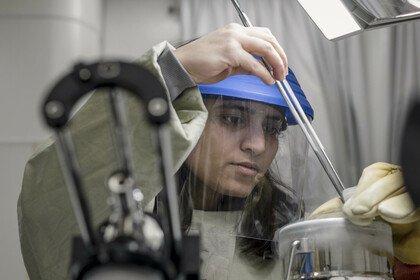
Roof in Pretoria is painted with a heat-reducing coating as part of the Heat Adaptation for Pregnant
women and Infants study.
Credit:

Gulshan Khan / Wellcome

Licence: All Rights Reserved
Report summary

Wellcome Annual Report 2025

Find out about Wellcome’s impact in 2024/25, with commentaries from our Chair and CEO, reports on what we did last year and reviews of our finances and investments. 

Credit:

Gulshan Khan / Wellcome

Licence: All Rights Reserved

John-Arne Røttingen, CEO of Wellcome:

It feels like the world is becoming more complex and the challenges we face are getting harder.

Science offers some solutions, but science alone doesn't change the world. We need to combine discovery with solutions and action if we want to build a healthier future for everyone.

That's why last year we invested £1.9 billion, around $2.5 billion USD, in understanding how life and health work from the molecular level to the society level, and in tackling urgent global challenges: mental health, infectious disease and climate and health.

But we also invested in policy and influencing work. Science is great, but unless we can put discoveries in the lab into practice for the people who would benefit from them, it hasn't really fulfilled its potential.

We need to move from inventions to innovations. That means talking to governments, to businesses, and to other non-profits about how we get treatments into real world health care.

It also means highlighting how we prevent problems in the first place through immunisation, better mental health wellbeing, or limiting the damage caused by climate change.

Following government cuts, there are critical gaps in the system that supports the world's most vulnerable. In the short term, this is a crisis, a big crisis. In the long term? We need to find a way to create a global health system that's efficient, robust for the future and, crucially, driven by the needs of the people it's intended to benefit.

In our Annual Report, there are many examples of potentially life changing discoveries that we’ve supported.

One example: Plague is an infectious disease that can kill. We have a treatment against it, but it requires an injection. This year in Madagascar, a trial we supported proved that a simple oral antibiotic treats the plague just as effectively as the injection. It sounds small, but it means care can move out of hospitals and directly into the rural communities that need it most, improving access and cutting costs.

But again, for discoveries like this to make a difference, we need the global health system to be fit for the future, sustainable, and work for the people who need it most.

In the last year, we've worked with partners around the world to spark debate about options for radical reform to get a more equitable, effective and efficient global health ecosystem. This year, I'll be continuing to highlight this pressing issue.

The world may be uncertain, but we at Wellcome are continuing to work for a healthier future for everyone.

Highlights 

The past year marked significant progress in Wellcome's commitment to transformative health advancements through strategic investments and collaborations.

  • Financial commitment: In the 2024/25 period, Wellcome invested £1.9 billion in supporting science, health and wellbeing, while addressing urgent global health challenges.
  • Innovative advancements: A trial proved that a simple oral antibiotic treats plague as effectively as an injected one, bringing treatment into the rural communities where it's most needed. A start-up from Cardiff University is developing molecules that change how brain receptors work, which could lead to more effective mental health treatments.
  • Strategic partnerships: Wellcome, the Novo-Nordisk Foundation and the Gates Foundation launched the Gram-Negative Antibiotic Discovery Innovator (GRAM-ADI). This £37 million consortium will accelerate the discovery of new drugs for Gram-negative bacteria, which are among the leading causes of death from antimicrobial resistance.
  • Long-term impact: We have supported mitochondrial research in Newcastle for over 30 years. Now, eight healthy babies have been born in the UK through mitochondrial donation, a specialist IVF technique that prevents inherited mitochondrial disease. This achievement reflects decades of curiosity-driven research, showing how discoveries can lead to life-changing health impact.
  • Global health advocacy: During COP30, we launched an initial $300 million fund as part of the new Climate and Health Funders Coalition - a global group of philanthropies committed to accelerating action on challenges like extreme heat, air pollution and infectious disease.
  • Investment growth: Despite economic challenges, our robust investment management has ensured strong returns and positioned us to seize future opportunities, continuing our relentless pursuit of improved health outcomes for all. 
Chart visible

Source: Wellcome

In 2024/25, Wellcome's charitable expenditure was £1,916 million – the third year of a ten-year plan to spend £16 billion.

"Science alone doesn’t change the world. At Wellcome, we combine discovery with equity and action to turn knowledge into solutions that improve health everywhere, even amid global uncertainty."

John-Arne Røttingen

Chief Executive Officer

Wellcome

Connect with John-Arne:

Examples of our work in 2024/2025 

Impact story
Impact story

Mitochondrial donation: the pioneering IVF treatment giving families hope

5-minute read

The first healthy babies born in the UK thanks to mitochondrial donation show what science can achieve when combined with advocacy and engagement to build trust. Wellcome has funded the research, convened the public engagement that saw UK law change and supported the clinical trial that will give families hope for a healthier future.

News
News

Researchers take first steps to creating synthetic human genomes

4-minute read

A team of UK-based scientists are developing technology to create the first synthetic human chromosome. The ability to write large genomes has the potential to transform our understanding of human health, opening opportunities to develop cell therapies, climate-resistant crops and more. 

Expert perspectives
Author
Expert perspectives
Author

AI and mental health: “it could help revolutionise treatments”

5-minute read

Professor Miranda Wolpert is Director of Mental Health at Wellcome. Here, she gives her insights into the opportunities and risks of AI in mental health – and why we must approach the potential of AI with curiosity and not assumption.

Author

Downloads 

Download previous annual reports 

Contact us